How to find a shampoo without coconut: what else can make foam
Nearly every shampoo cleanser is built on coconut or palm kernel oil, including several with no 'coco' in the name. The four kinds of product that aren't, the names to stop trusting, and what to check in the rest of the bottle.
Published October 1, 2026 · 6 min read
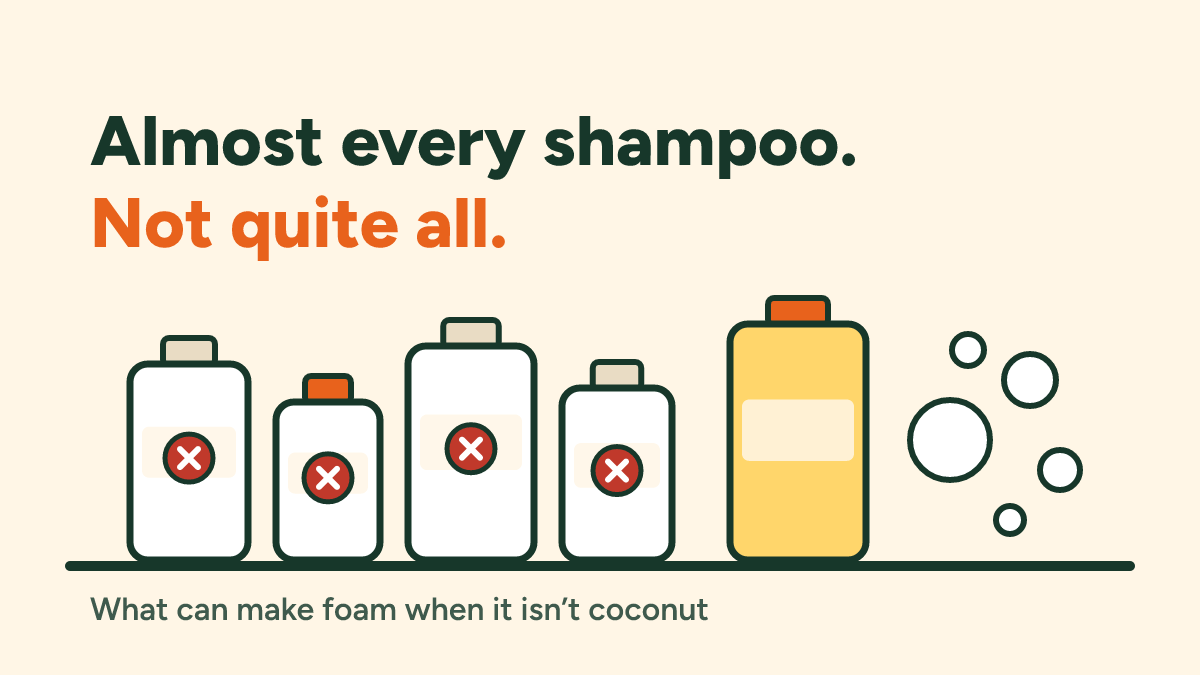
Shampoo is the hardest thing on this site to shop for. Of the shampoos in our registry, almost all contain a coconut-derived cleanser: the current count is here. That isn't bad luck with brands. It is how shampoo is made.
This page explains why, and then the four kinds of product that get around it.
Why nearly all of them have it
What makes a shampoo foam is a surfactant, and most surfactants are built on a fatty chain about twelve carbons long. Chains of that length come from the "lauric" oils, which are coconut oil and palm kernel oil, or else from petroleum [1].
So the tell-tale is not only the word coco. It is any name built on lauryl, laureth or lauroyl, because lauric acid is commonly isolated from coconut oil [2].
| On the label | What it is made from |
|---|---|
| Cocamidopropyl betaine, cocamide MEA, cocamide DEA | Coconut [3] |
| Sodium cocoyl isethionate | Coconut: the coconut fatty acid ester of isethionic acid [4] |
| Sodium methyl cocoyl taurate | Coconut fatty acid [5] |
| Sodium cocoamphoacetate, disodium cocoamphodiacetate | Coconut oil [6] |
| Sodium cocoyl glutamate, sodium lauroyl glutamate | Coconut acid and lauric acid from coconut oil [7] |
| Sodium lauroyl sarcosinate | Sarcosine joined to a fatty acid; the lauric acid is commonly from coconut [2, 8] |
| Sodium lauroyl methyl isethionate | A lauric acid ester [4] |
| Sodium lauryl sulfate, sodium laureth sulfate, ammonium lauryl sulfate | A C12–C14 alcohol from coconut or palm kernel oil, or from petroleum [1, 9] |
| Decyl glucoside, lauryl glucoside, coco-glucoside | An alcohol from coconut or palm oil, joined to glucose [10] |
| Disodium laureth sulfosuccinate | An ethoxylated lauryl alcohol; the source of the alcohol isn't stated [11] |
The two in bold are the ones sold as the gentle, sulfate-free alternative. They have no "coco" in the name, and they are coconut chemistry all the same. "Sulfate-free" is not coconut-free is the longer version of that.
The four ways out
1. Olefin sulfonate. Sodium C14-16 olefin sulfonate is made from ethylene, which is to say from petroleum [12]. Of all the common shampoo cleansers we checked, it is the only one whose manufacture has nothing to do with coconut or palm.
The catch is that it rarely works alone. It is usually paired with cocamidopropyl betaine or a cocamide to soften it. Finding it as the first cleanser is a good sign; you still have to read the rest of the list.
2. Saponins. Some plants make their own foaming compounds. Soapnut (Sapindus mukorossi) is a tree of the soapberry family [13]; quillaja and yucca are others [14, 15]. None of them is a palm, and none is related to coconut. One of the shampoos in our registry with nothing flagged at all is of this kind: a soapnut shampoo.
They lather less and feel different. That is the trade.
3. Real soap made from one oil. Soap is a fat reacted with lye, and its name tells you the fat: sodium olivate or potassium olivate is olive oil, sodium tallowate is beef fat, and sodium cocoate or potassium cocoate is coconut [2, 16].
Be careful with the word castile. The dictionary meaning is a soap made from olive oil [17]. But a best-selling "pure-castile" liquid soap lists coconut oil as its first ingredient after water, ahead of palm and olive [18]. Read the list, not the name on the front.
4. Nothing that lathers. Dry shampoo is an alcohol spray carrying starch that soaks up oil [19]; it cleans nothing, but it buys days between washes. A dry shampoo is one of the few in our registry with no coconut listed by name; the brand's US site lists a version that does include a coconut-derived ingredient, so read your own can. Rhassoul, a mineral clay from Morocco used for washing hair, has no plant in it at all [20].
Then read the rest of the bottle
A shampoo is more than its cleanser, and a conditioner has no cleanser to speak of. The thickeners and softeners are where the "can't be verified" ingredients live.
- Cetyl alcohol is made from coconut oil or tallow, or built from ethylene [9]. Stearyl alcohol is made synthetically or from natural fats [21]. The label says which in neither case.
- Glycerin is a by-product of processing any fat or oil, and can be synthetic [22].
- Behentrimonium chloride has a plant source that the industry's safety review doesn't name [23].
- Stearamidopropyl dimethylamine, a common conditioning agent, is made by reacting stearic acid with DMAPA [24]. DMAPA is the chemical implicated in cocamidopropyl betaine allergy. If that is what your patch test found, mention this ingredient to your dermatologist.
On this site those are marked "can't be verified", and they are what our letters to brands ask about. Conditioner, styling products and hair dye has its own page.
Is it getting better or worse?
Worse, if anything. In 2005 about half of the world's capacity for making fatty alcohols was petroleum-based. By 2012 capacity had grown to 3.35 million tonnes, and all of that growth was plant-based [25]. Every brand that moves to "plant-derived" or "naturally derived" cleansers is, in practice, moving towards coconut and palm kernel.
That is the uncomfortable part of this allergy: the greener the bottle, the more likely it is.
What to do with this
- Decide what you are avoiding. If your allergy is to coconut as food, the evidence that refined cleansers matter is thin. If it is a contact allergy, the cleanser is exactly the problem. The two kinds of coconut allergy.
- Look for one of the four routes above, then read the whole list.
- Photograph the label and the checker marks every name on this page.
- Start from what has already been read: the shampoos and hair care in the registry.
Related
"Sulfate-free" is not coconut-free · Where coconut hides · Coconut's many names · The complete guide
Sources
- Schowanek D. et al. International Journal of Life Cycle Assessment, 2018. PDF
- Cosmetic Ingredient Review. Safety assessment of fatty acids and fatty acid salts, 2018. PDF
- Cosmetic Ingredient Review. Safety assessment of diethanolamides, 2011. PDF
- Cosmetic Ingredient Review. Safety assessment of isethionate salts, 2013. PDF
- Cosmetic Ingredient Review. Safety assessment of alkyl taurate amides, 2015. PDF
- Cosmetic Ingredient Review. Safety assessment of fatty amphocarboxylates, 2025. PDF
- Cosmetic Ingredient Review. Safety assessment of amino acid alkyl amides, 2013. PDF
- Cosmetic Ingredient Review. Safety assessment of fatty acyl sarcosines, 2016. PDF
- NIH PubChem. “1-Dodecanol” and “1-Hexadecanol”, methods of manufacturing. Lauryl alcohol · Cetyl alcohol
- Cosmetic Ingredient Review. “Final Safety Assessment: Decyl Glucoside and Other Alkyl Glucosides”, 2011. PDF
- Cosmetic Ingredient Review. Safety assessment of alkyl PEG sulfosuccinates, 2012. PDF
- Cosmetic Ingredient Review. Safety assessment of sodium alpha-olefin sulfonates. PDF
- Sochacki M., Vogt O. Plants, 2022; 11: 2355. PMC
- EFSA. Re-evaluation of Quillaia extract (E 999). EFSA Journal, 2019. PMC
- Jiménez G.G. et al. Molecules, 2021; 26: 5251. PMC
- Cosmetic Ingredient Review. Safety assessment of plant-derived fatty acid oils, 2011. PDF
- Collins English Dictionary, “castile soap”, via dictionary.com
- Dr. Bronner's. Baby Unscented Pure-Castile Liquid Soap, ingredients. drbronner.com
- Draelos Z.D. “Does dry shampoo work?” Dermatology Times, 2017. dermatologytimes.com
- Benhammou A. et al. Clays and Clay Minerals, 2009; 57: 264–270. cambridge.org
- Cosmetic Ingredient Review. Safety assessment of stearyl alcohol, 1985. PDF
- Cosmetic Ingredient Review. Safety assessment of glycerin, 2014. PDF
- Cosmetic Ingredient Review. Safety assessment of trimoniums, 2010. PDF
- Cosmetic Ingredient Review. Safety assessment of fatty acid amidopropyl dimethylamines, 2014. PDF
- Shah J. et al. Journal of Surfactants and Detergents, 2016; 19: 1333–1351. PDF
Educational only, not medical advice. Always confirm with your allergist.