“Sulfate-free” makes coconut more likely, not less
Sulfate-free, oil-free, vegan, natural, gluten-free: five claims that sound like reassurance and tell you nothing about coconut. One of them actively works against you. Read off 20 shampoo bottles in Panama.
Published September 29, 2026 · 4 min read
I checked twenty shampoos. Eighteen contain coconut.
Of the two that don't, one is a dry shampoo — rice starch and propellant, no washing involved. That leaves exactly one wash-off shampoo in the whole registry that I can put a green mark against.
What makes this worth writing down isn't the number. It's that several of those eighteen bottles are covered in claims that a person with a coconut allergy reads as safe.
The claim that works against you
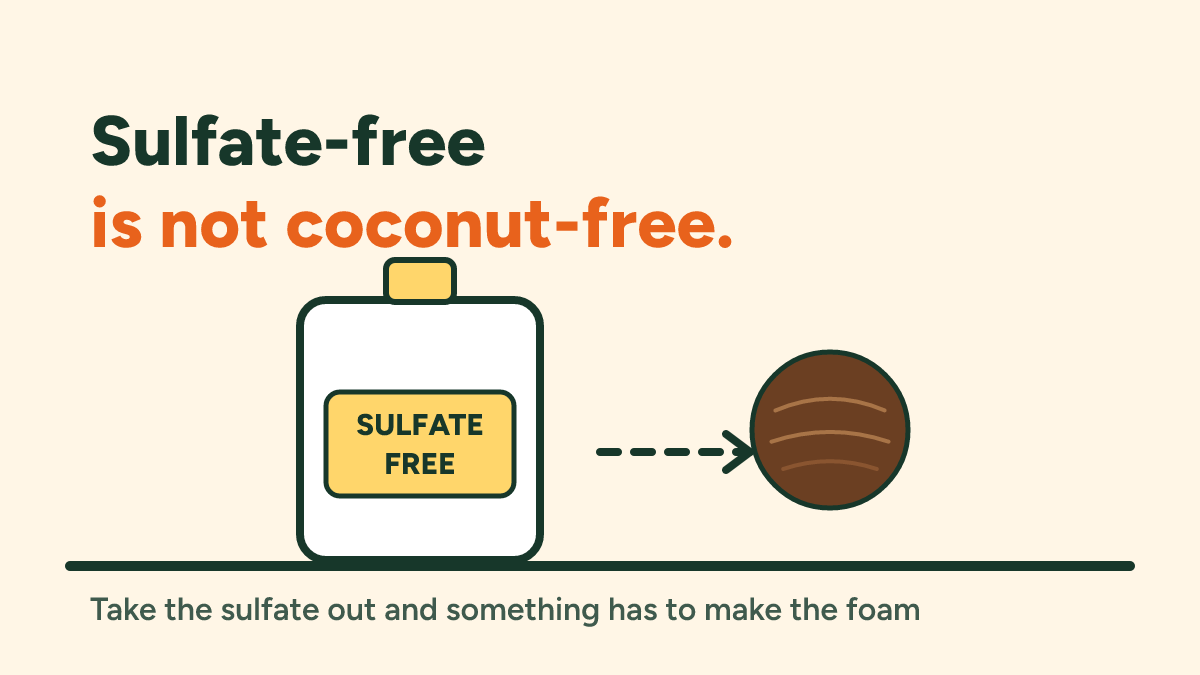
Here is the thing nobody tells you: taking sulfates out of a shampoo usually means putting coconut in.
Sulfates — sodium lauryl sulfate, sodium laureth sulfate — are the cheap, effective detergents that make a shampoo foam. When a brand removes them, it still needs something to clean and foam. The replacements the industry reaches for are almost all made from coconut oil:
- cocamidopropyl betaine
- sodium cocoyl isethionate
- coco-glucoside
- cocamidopropyl hydroxysultaine
- disodium cocoamphodiacetate
Look at the names. They are not hiding it. Coco. It is right there in the INCI, and it is there precisely because the sulfate came out.
So "SULFATE-FREE" on the front of a bottle is not neutral information for us. It is a mild signal in the wrong direction.
Alfaparf's Keratin Therapy shampoo says SULFATE-FREE on the front. The back adds FREE FROM: SULFATES, MINERAL OIL, PARAFFINS. The ingredient list contains Coconut Acid — under that exact name — plus cocamidopropyl hydroxysultaine, sodium cocoyl isethionate, coco-glucoside and cocamidopropyl betaine. Five coconut ingredients on a bottle that advertises what it leaves out.
It isn't one brand having a bad day. Semi di Lino, from the same company, also says SULFATE-FREE, and carries three.
Five claims, and what each one actually excludes
Sulfate-free. Excludes sulfates. Often achieved with coconut. See above.
Oil-free. Excludes facial oils, which is a claim about how greasy a product feels on skin. It says nothing about coconut-derived surfactants, which are not oils by the time they reach the bottle. Neutrogena's Oil-Free Acne Wash contains two of them.
Vegan. This one deserves a moment. Coconut is a plant. Vegan certification is a promise about animals, and coconut passes it effortlessly. A vegan product is, if anything, more likely to use plant-derived surfactants — which in practice means coconut. The Kativa Vitamin-E shampoo carries SALT FREE, SULFATE FREE, GLUTEN FREE and a Vegan mark on the front, and cocamidopropyl betaine third in the list.
Gluten-free. A different allergy entirely. Useful to somebody; irrelevant to you.
Natural / eco / botanical. No legal definition, and the same trap as vegan: a brand leaning on plant ingredients is reaching for the same coconut chemistry as everyone else. In my earlier run through seventy products, the "natural" shelf was worse than the mainstream one, not better.
Why "free from" lists never say coconut
A "free from" list is a marketing document. It names the things the brand believes its customers are frightened of this year — sulfates, parabens, silicones, gluten, mineral oil.
Coconut allergy is rare enough that it has never made that list. It never will, until enough of us ask.
Which means the absence of coconut from a "free from" panel tells you nothing whatsoever. Not that the product is clear. Not that anyone checked. Only that nobody in the brand's marketing meeting mentioned it.
The one that was honest
Credit where it is due. Alfaparf's Yellow Nourishing shampoo — same company as the two above — says POWERED BY ARGAN & COCONUT OILS across the front in large letters.
It is the only bottle in the registry I did not have to turn over. Coconut as a selling point is, for us, the most useful labelling there is: instantly readable, no chemistry required, no guessing. I would rather have a hundred of those than one more "free from" panel.
What to do instead
Ignore the front of the bottle. Every claim on it was written to answer somebody else's worry.
Turn it over and read three things. Anything containing coco. Anything containing lauryl, laureth or lauroyl — coconut oil is roughly half lauric acid, so these usually come from coconut or palm kernel. And any unnamed vegetable oil, which can be either.
Expect shampoo to be the hard one. Eighteen of twenty. It is the single worst category in this registry, and the reason is structural: a shampoo has to foam, and the world makes its foam out of coconuts.
When you find one that works, buy several. The one clear shampoo I have found lathers with soap nut — Sapindus saponaria, a berry — and every ingredient on it is named with its botanical name. That is rare enough to be worth stocking up on.
Every product named here links to its page, with the full ingredient list as I read it off the packet and the date I read it. If you spot something wrong, tell me — I would rather be corrected than trusted.
Educational only, not medical advice. Always confirm with your allergist.