Coconut allergy or cocamidopropyl betaine allergy? The two kinds, explained
One is a food allergy that acts in minutes. The other is a skin allergy to ingredients made from coconut, and it shows up a day later. They are tested differently, avoided differently, and having one does not mean you have the other.
Published October 1, 2026 · 7 min read
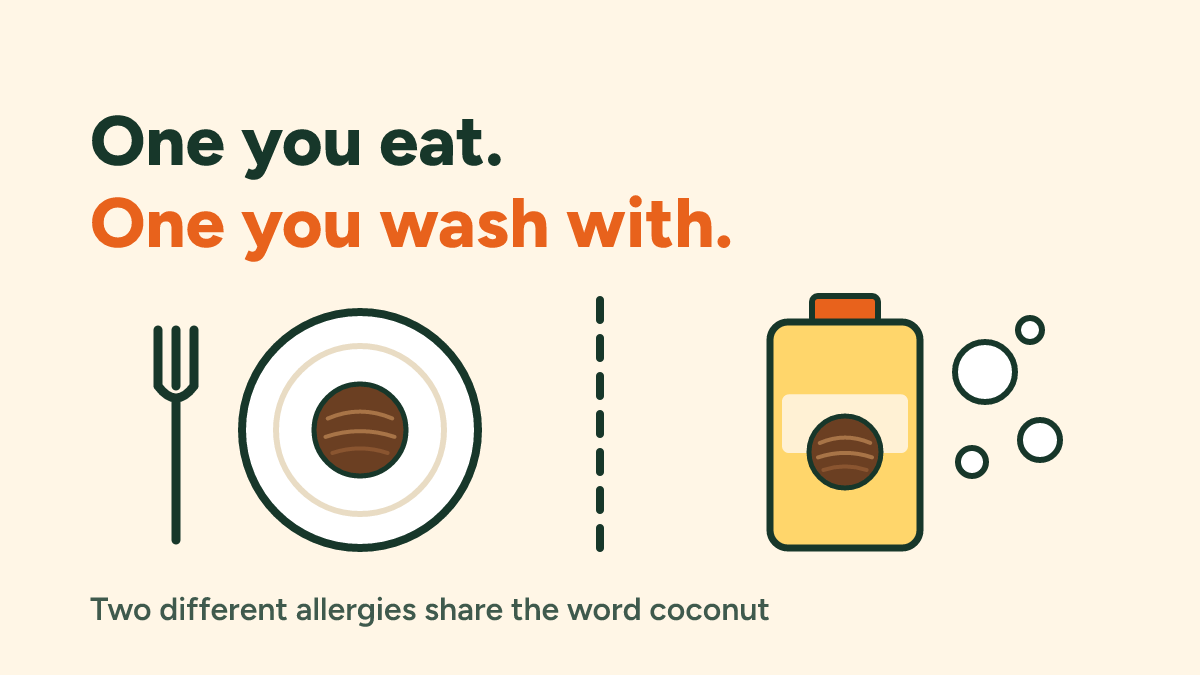
"Coconut allergy" is one name for two different things. Mix them up and you get told, with total confidence, that you can't be allergic to coconut because you ate a curry last week. Or you throw out your shampoo for an allergy you have only ever had at the table.
Both are real. They work differently, they are found with different tests, and one does not imply the other.
Side by side
| Food allergy | Contact allergy | |
|---|---|---|
| What reacts | IgE antibodies to coconut protein | T-cells, to certain ingredients made from coconut, or to impurities in them |
| How fast | Minutes, usually | A day or two after contact, and it lingers for days [1] |
| What it looks like | Hives, swelling, vomiting, wheeze, anaphylaxis | An itchy red rash where the product sat: eyelids, scalp, face, hands |
| Set off by | Eating coconut | Shampoo, body wash, soap, hand cleanser |
| Found with | Skin prick test, blood test, food challenge | Patch test |
Australia's allergy society sums up which is which in two sentences: allergic reactions to eating coconut are relatively rare, and contact allergic dermatitis to coconut products is more common [1].
The quickest clue is the clock
A reaction within minutes of eating or touching something points to the food kind. A rash that turns up the next day, where a product touched you, points to the contact kind. Write down which it was. It decides which test you need.
Is a cocamidopropyl betaine allergy a coconut allergy?
Not in the food sense.
Cocamidopropyl betaine (CAPB) is the foaming agent in a great many shampoos and washes, and it is made starting from coconut fatty acids. It was named Allergen of the Year in 2004 [4]. But what people react to is mostly not the coconut part.
Making CAPB leaves traces of two other chemicals behind, amidoamine and dimethylaminopropylamine (DMAPA). The research points at these impurities as the actual cause in most cases [2, 4]; one study concluded that cocamidopropyl betaine itself "is probably not an allergen" [3].
That isn't fully settled. The same researchers who first blamed amidoamine wrote that CAPB itself might still be the allergen in rare cases [2], and a 2026 report found that only half of patients allergic to these betaines tested positive to the known impurities [5]. Something else is going on in the other half, and nobody has pinned it down.
How common is it? Among 10,877 people sent for patch testing in North America, 1.4% reacted to CAPB, 1.7% to DMAPA and 0.8% to amidoamine [6]. Those are people who already had a skin problem bad enough to be tested, not the general public.
The other coconut-derived ingredients known for it
- Alkyl glucosides (decyl glucoside, lauryl glucoside and their relatives), the "gentle" cleansers in natural and baby products. Allergen of the Year in 2017 [7]. Of 24,097 people patch-tested to decyl or lauryl glucoside, 2.0% reacted, and cross-reactivity between the two was over 40% [8]. If one of the family is your problem, treat the others with suspicion.
- Cocamide DEA (coconut diethanolamide), mostly in hand cleansers and washing-up liquids. It can cause contact dermatitis, particularly on the hands [9]; in one occupational clinic, 25 of 2,572 patients tested, about 1%, were allergic to it [10]. Australia's allergy society names it among the coconut-derived products that cause contact dermatitis [1].
Coconut's many names lists what each of these is called on a label, and which products in the registry contain them.
If you have the contact kind, must you stop eating coconut?
We looked for any allergy or dermatology organisation that says so, and found none. The British Society for Cutaneous Allergy's leaflet on CAPB is about what goes on your skin: it tells you to avoid putting products containing it onto your skin [11]. It says nothing about food.
That fits the mechanism. If the thing you react to is a manufacturing impurity in a surfactant, a coconut on a plate doesn't contain it.
There is one small study worth knowing about. Twelve people with CAPB allergy were patch-tested with coconut oil, lauric acid and eleven coconut-derived surfactants. Only one of those surfactants produced a significantly higher rate of reactions; coconut oil itself did not [12]. Twelve people is not much, and the same study found CAPB reactions hard to reproduce on retesting [12].
So: nothing we found says a contact allergy to CAPB means avoiding coconut as food. Take that to your dermatologist as a question, not as our answer.
If you have the food kind, do shampoos matter?
This is the question with the least evidence behind it, and it is better to say so than to guess.
What is known:
- Food allergy is a reaction to protein [13]. A surfactant like CAPB is several chemical steps away from anything resembling coconut protein.
- Coconut on the skin can cause immediate reactions in people with the food allergy. In a US children's hospital study, ten children reacted through skin contact: three with hives, one with widespread itching, six with a rash. None of those reactions was anaphylaxis [14]. There is a published case of hives all over the body from coconut oil applied to the skin [15].
- Coconut oil is the ingredient to take seriously. Anaphylaxis UK notes that coconut oil is usually cold-pressed, which means unrefined, so it could cause a reaction [16]. In a Sri Lankan laboratory study, blood from 4 of 18 people allergic to coconut milk showed antibodies binding to proteins in an unrefined coconut oil, though only one of them had ever reacted to coconut oil [17].
What isn't known:
- Whether refined coconut oil is a problem. An expert answer from the American Academy of Allergy, Asthma & Immunology says refined coconut oil should not contain protein allergens [18]. Anaphylaxis UK is more careful: it's not known if fully refined coconut oil would cause a reaction [19].
- Whether the refined derivatives in cosmetics cause reactions in food-allergic people at all. Anaphylaxis UK says plainly that how likely these products are to cause allergic reactions is not known [19].
That gap is the reason this site works the way it does. It can't know which kind of allergy you have, or how you react to a derivative three steps removed from the fruit, so it marks every coconut-derived ingredient and leaves the decision to you and your allergist. A product marked "contains coconut" here contains an ingredient made from coconut. Whether that matters for you is the part only testing and experience can answer.
Can you have both?
Yes. Nothing about one protects you from the other, and the specialists who answer questions for the AAAAI note that while most skin reactions to coconut are the delayed, cell-mediated kind, IgE-mediated ones on the skin have been reported too [20].
If your reactions don't fit neatly into one column of the table, that may be why.
Finding out which you have
Different tests, usually different clinics. How coconut allergy is diagnosed goes through each one. The short version: a prick or blood test will not find a contact allergy, and a patch test will not find a food allergy. If you have only ever had one set done, you have only had half the question asked.
Related
Coconut allergy symptoms · Where coconut hides · How it's diagnosed · The complete guide
Sources
- ASCIA (Australasian Society of Clinical Immunology and Allergy). “Coconut allergy.” Updated April 2024. allergy.org.au
- Fowler J.F., Fowler L.M., Hunter J.E. “Allergy to cocamidopropyl betaine may be due to amidoamine.” Contact Dermatitis, 1997. PubMed
- Suuronen K., Pesonen M., Aalto-Korte K. “Occupational contact allergy to cocamidopropyl betaine and its impurities.” Contact Dermatitis, 2012. PubMed
- Jacob S.E., Amini S. “Cocamidopropyl betaine.” Dermatitis, 2008. PubMed
- Iijima S., Murayama K., Takayama N. et al. “Two cases of allergic contact dermatitis caused by coco betaine in clobetasol propionate shampoo.” Case Reports in Dermatological Medicine, 2026. PMC
- Fowler J.F. Jr. et al. “Cutaneous delayed-type hypersensitivity to surfactants.” Dermatitis, 2015. PubMed
- Sasseville D. “Alkyl glucosides: 2017 ‘Allergen of the Year’.” Dermatitis, 2017. PubMed
- Warshaw E.M. et al. “Patch testing with glucosides: the North American Contact Dermatitis Group experience, 2009–2018.” Journal of the American Academy of Dermatology, 2022. PubMed
- Duffill M. “Coconut diethanolamide allergy.” DermNet. dermnetnz.org
- Aalto-Korte K., Pesonen M. et al. “Occupational allergic contact dermatitis caused by coconut fatty acids diethanolamide.” Contact Dermatitis, 2014. PubMed
- British Society for Cutaneous Allergy. “Cocamidopropyl betaine” patient information leaflet. cutaneousallergy.org
- Shaffer K.K. et al. “Allergenicity and cross-reactivity of coconut oil derivatives.” Dermatitis, 2006. PubMed
- Anaphylaxis UK. “Cosmetics and medicines for people with food allergies” factsheet, 2025. PDF
- Kruse L., Lor J., Yousif R. et al. “Coconut allergy: characteristics of reactions and diagnostic predictors in a pediatric tertiary care center.” Annals of Allergy, Asthma & Immunology, 2021. PMC
- Anagnostou K. “Coconut Allergy Revisited.” Children, 2017. PMC
- Anaphylaxis UK. “Plant-based oils” factsheet. anaphylaxis.org.uk
- Iddagoda J. et al. “Identification of allergens in coconut milk and oil with patients sensitized to coconut milk in Sri Lanka.” Clinical and Molecular Allergy, 2022. PMC
- AAAAI, Ask the Expert. “Coconut.” November 2025. aaaai.org
- Anaphylaxis UK. “Seeds and foods with ‘nuts’ in the name” factsheet, 2024. PDF
- Ledford D.K., Sicherer S. “Coconut contact urticaria and specific IgE.” AAAAI, Ask the Expert. aaaai.org
Educational only, not medical advice. Always confirm with your allergist.