MCT oil and coconut allergy: what it is made from, and what nobody has tested
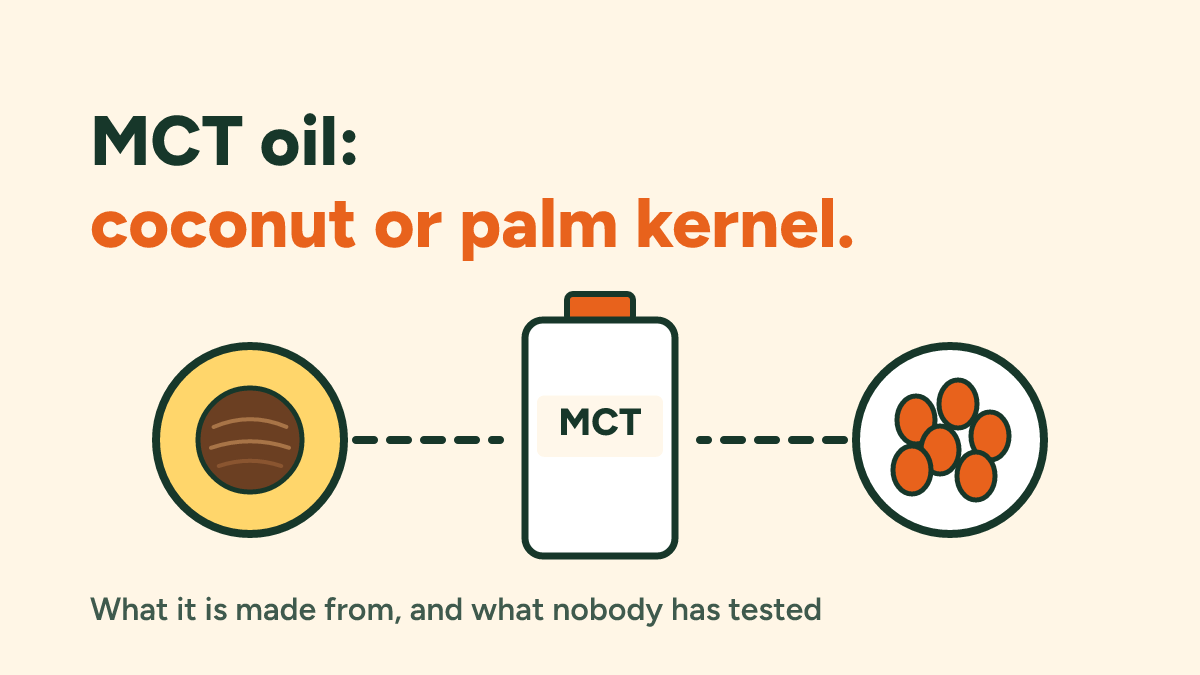
MCT oil is made from coconut oil, palm kernel oil or both, and the label often doesn't say which. Where it turns up, in supplements, medical formulas, medicines and cosmetics, what is known about reactions, and what has never been measured.
Published October 1, 2026 · 6 min read
Don't stop a prescribed formula, feed or medicine because of this page.
MCT is in medical products that people depend on. If one of yours contains it and you have a coconut allergy, keep taking it and ask your doctor, dietitian or pharmacist. There are no published reports of anyone reacting to MCT.
The short answer: MCT oil is made from coconut oil, palm kernel oil, or a mix of the two. It is far more processed than coconut oil. Nobody has published a measurement of coconut protein in it, we found no report of anyone reacting to it, and no allergy organisation mentions it at all. That adds up to probably low risk, never tested, which is a question for your allergist and not something a label can settle.
What it is
MCT stands for medium-chain triglycerides: fats built from short fatty acids, almost entirely caprylic (C8) and capric (C10) [1, 2].
It is not a pressed oil. The fatty acids are separated out of a vegetable oil, most commonly coconut or palm kernel, and then joined back onto glycerol to make a new fat [1]. The drug-ingredient standards list the same two plants as the source: coconut and oil palm [3].
So an MCT oil is coconut or palm kernel oil that has been taken apart and partly rebuilt. That is a long way from the coconut, and it is still where it came from.
The names it goes by
- Medium-chain triglycerides, or MCT oil, on supplements and foods
- Caprylic/capric triglyceride, on cosmetics. The cosmetics industry's own safety review describes it as made by splitting coconut oil and separating out the medium-length fatty acids [4]
- Fractionated triglyceride of coconut oil, on some medicine labels [5]
- Modified coconut and/or palm kernel oil, on some medical nutrition products [6]
On this site, caprylic/capric triglyceride is marked as coconut. The products that contain it.
Where it turns up
Supplements. MCT oil is sold by the bottle for ketogenic diets and sports nutrition, and added to coffee creamers, powders and bars.
Medical nutrition. This is where it matters most, because these products are prescribed.
- Nestlé Health Science's MCT Oil lists "modified coconut and/or palm kernel oil (medium chain triglycerides)" [6].
- Monogen, a formula for fat malabsorption, lists medium chain triglycerides from "coconut and/or palm oil" [7].
- Pregestimil gets 55% of its fat from MCT oil, and its ingredient list doesn't say what the MCT is made from [8].
Intravenous nutrition. Lipid emulsions given into a vein, such as SMOFlipid and Lipofundin MCT/LCT, contain MCT. Their official labels don't state its source, and coconut does not appear among their warnings: SMOFlipid's lists fish, egg, soybean and peanut [9, 10].
Medicines. MCT is a common filler in soft capsules. One example shows how arbitrary the source can be: a manufacturer's calcitriol capsules use "a fractionated triglyceride of coconut oil", while the same manufacturer's calcitriol oral solution uses one made from palm seed oil [5]. Same drug, same company, different plant. Coconut in medicines.
Cosmetics. As caprylic/capric triglyceride, in creams, sunscreens and makeup.
Can you tell which plant it came from?
Usually not.
Some labels say "and/or", which means either. Some give no source at all. Food labelling rules in the EU and the US do require vegetable oils to be named by plant, but they allow "and/or" wording, and neither text says whether a rebuilt fat like MCT counts as the oil it started from [11, 12].
If the source matters to you, the manufacturer is the only one who knows, and it may change between batches. That is the reason "and/or" is on the label.
What is known about reactions
No measurement. We found no study that measured protein in MCT oil.
No reported case. We found no published report of an allergic reaction to MCT oil, or to a product where MCT was the suspected cause. The nearest cases involve coconut oil: an infant formula in 1994 [13], and hives from coconut oil applied to the skin [14].
No guidance. None of the allergy organisations we checked mentions MCT. What they say about coconut oil doesn't agree:
- Allergy specialists answering for the AAAAI write that oils typically don't contain significant amounts of allergenic protein [15], and that they could not find convincing case reports of reactions to coconut oil, so it "seems unlikely it would be an issue" [16]. An older answer on the same page is more careful: with at least one reported case, a reaction can't be ruled out [16].
- Anaphylaxis UK says fully refined oils are unlikely to cause a reaction, but notes that this has only been researched for a couple of oils and coconut isn't one of them [17]. Its coconut factsheet says coconut oil is usually sold cold-pressed and unrefined, and should be avoided [18].
- A Sri Lankan study of people sensitised to coconut concluded they should be advised to use refined coconut oil rather than unrefined [19].
So where does that leave MCT?
This part is reasoning, not evidence, and it is ours.
Food allergy is a reaction to protein. Refining removes most protein from an oil. MCT goes further than refining: the oil is split into its fatty acids, those are distilled, and the result is rebuilt into a new fat. Each of those steps is a reason to expect very little coconut protein to survive.
But expecting is not measuring, and nobody has measured. A reasonable allergist could tell you MCT is fine, and a careful one could tell you to avoid it, and both would be reading the same absence of data.
What to do
- A supplement you are choosing to take: ask your allergist first. There is no need to find out by experiment.
- A formula, feed or medicine you have been prescribed: keep taking it, and ask. Say that it contains MCT, that MCT can be made from coconut, and that you have a coconut allergy. Let them weigh it.
- If the source matters: ask the manufacturer whether the MCT is from coconut, palm kernel or both, and whether that is fixed.
- If your allergy is the skin kind, the question is different again. The two kinds of coconut allergy.
Related
Coconut and palm oil · Coconut in medicines · Babies and children · The complete guide
Sources
- US FDA. Response letter, GRAS Notice GRN 001049 (medium-chain triglycerides), 2022. PDF
- Watanabe S., Tsujino S. “Applications of Medium-Chain Triglycerides in Foods.” Frontiers in Nutrition, 2022. PMC
- Health Canada, Natural Health Products Ingredients Database. “Medium-chain triglycerides.” hc-sc.gc.ca
- Cosmetic Ingredient Review. “Amended Safety Assessment of Triglycerides as Used in Cosmetics”, 2018. PDF
- Calcitriol capsules and oral solution, prescribing information. DailyMed, US National Library of Medicine. dailymed.nlm.nih.gov
- Nestlé Health Science Canada. MCT Oil, ingredients. nestlehealthscience.ca
- Nutricia UK. Monogen, ingredients. nutricia.co.uk
- Mead Johnson. Pregestimil, ingredients. hcp.meadjohnson.com
- SMOFlipid, prescribing information. DailyMed. dailymed.nlm.nih.gov
- Lipofundin MCT/LCT 20%, Summary of Product Characteristics. medicines.org.uk
- Regulation (EU) No 1169/2011, Annex VII, Part A. legislation.gov.uk
- US 21 CFR 101.4(b)(14). law.cornell.edu
- Couturier P. et al. “A case of coconut oil allergy in an infant: responsibility of ‘maternalized’ infant formulas.” Allergie et Immunologie, 1994. PubMed
- Anagnostou K. “Coconut Allergy Revisited.” Children, 2017. PMC
- AAAAI, Ask the Expert. “Coconut.” 2022. aaaai.org
- AAAAI, Ask the Expert. “Coconut oil and palm oil with multiple food allergies.” aaaai.org
- Anaphylaxis UK. “Plant-based oils” factsheet. anaphylaxis.org.uk
- Anaphylaxis UK. “Coconut allergy” factsheet, 2019. PDF
- Iddagoda J. et al. “Identification of allergens in coconut milk and oil with patients sensitized to coconut milk in Sri Lanka.” Clinical and Molecular Allergy, 2022. PMC
Educational only, not medical advice. Always confirm with your allergist.