Coconut oil allergy: virgin, refined, on your skin and in your food
Can you be allergic to coconut oil? What the grades mean (virgin, refined, hydrogenated, fractionated), what has actually been reported, why the label rarely tells you which grade it is, and the problem with using coconut oil on eczema.
Published October 1, 2026 · 6 min read
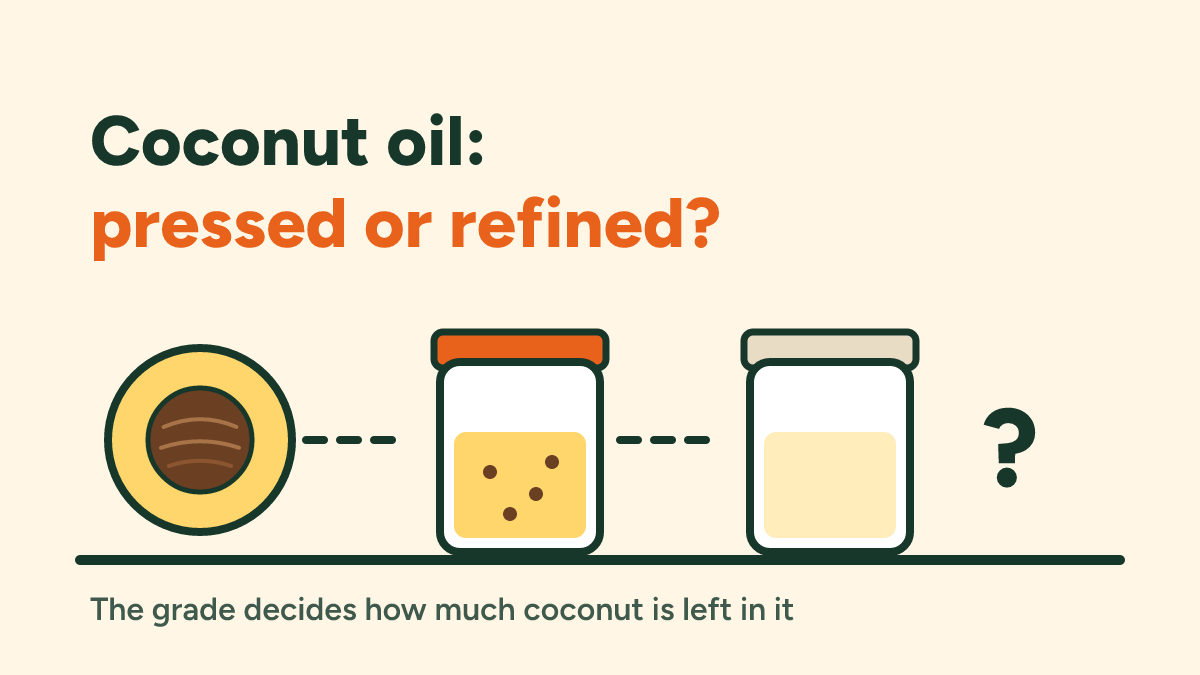
The short answer: yes, people have reacted to coconut oil, both eating it and putting it on their skin. How likely it is depends on how the oil was made, and on which kind of coconut allergy you have. The evidence is thinner than you would hope for something this common.
The grades, and why they matter
An allergy to a food is an allergy to its protein. Oil is fat. The question with any oil is how much protein came along with it, and that depends on the processing.
- Virgin or cold-pressed. Pressed from the coconut by mechanical means only, with no chemical refining; "cold-pressed" means no heat was applied either [1]. This is the oil in the jar that smells of coconut.
- Refined (RBD). Made from copra, the dried kernel, then refined, bleached and deodorised: neutralised with alkali, filtered through bleaching earth or carbon, and steamed [2, 3]. It has no smell.
- Hydrogenated. Coconut oil hardened by hydrogenation [4]. Common in non-dairy creamers and whipped toppings.
- Fractionated, or MCT. Not really coconut oil any more: a blend of two of its fatty acids, taken out and rebuilt [3]. MCT oil has its own page.
The more an oil is processed, the less protein you would expect to be left. How much less, for coconut oil specifically, has not been properly measured: the figures quoted in the medical papers disagree with each other about the units, so we are not repeating them.
What the allergy organisations say
They don't agree, and it helps to know that.
- Anaphylaxis UK says coconut oil is usually sold cold-pressed and unrefined, and should be avoided by people allergic to coconut [5]. On refined oil, it says the effect of refining has been researched only for other oils [6].
- The AAAAI's expert answers lean the other way: refined coconut oil should not contain protein allergens [7], and one specialist wrote that he could find no convincing case reports of reactions to coconut oil [8].
Both can be true. Unrefined oil is the one to treat as coconut. Refined oil is probably much lower risk and has not been proven so.
What has actually been reported
- Eating it. In a study of 41 coconut-allergic children in Singapore, coconut oil was the first thing two of them reacted to [9]. The study doesn't say which grade.
- In infant formula. One published case, from 1994 [10].
- On the skin. A published case of hives over the whole body after coconut oil was applied to the skin [11]. And in 2025, a case report titled "Coconut anaphylaxis induced by occupational sensitization to cosmetics via the skin in a spa therapist" [12]: an allergy that appears to have begun through the hands at work.
- In the laboratory. Researchers in Sri Lanka took blood from 18 people allergic to coconut milk and tested it against two unrefined coconut oils. The antibodies of four of them bound to proteins in the wet-processed oil, and one to the dry-processed oil. Only one of the eighteen had ever actually reacted to coconut oil, and the authors say their result can't be called conclusive. They did not test refined oil, and their advice was to use refined oil in preference to unrefined [13].
Is coconut oil a contact allergen?
Apparently not often. This is different from the food allergy above, and different again from the coconut-derived cleansers that cause most of the skin trouble.
The cosmetics industry's safety review records that coconut oil at full strength was not an allergen in a study of 12 people, and that a product containing it caused no reactions in a panel of 103 [4]. Plain coconut oil does not show up in the patch-test literature the way cocamidopropyl betaine and the glucosides do.
So if a product with coconut oil gives you a slow rash, the oil may not be the ingredient responsible. That is what patch testing sorts out.
You usually can't tell the grade from the label
- On food, "coconut oil" is all the ingredient list has to say. "Virgin" or "refined" appears if the maker chooses.
- On cosmetics, the name is Cocos Nucifera Oil whatever the grade. The industry review describes the refined, bleached, deodorised process, and then lists extra-virgin oils among the trade names sold under the same label name [4]. A "natural" or "organic" product is, if anything, more likely to use the unrefined kind.
There is no such thing as a certified allergen-free coconut oil. If the grade matters to you, the maker is the only source.
Coconut oil for eczema and allergies
A lot of people arrive at this subject from the other direction: coconut oil is recommended everywhere as a natural treatment for dry skin and eczema. There is real research behind that.
- In a trial of 117 children with eczema, eight weeks of virgin coconut oil reduced the severity score by 68%, against 38% for mineral oil [14].
- In adults with eczema who carried Staphylococcus aureus on their skin, after four weeks only 5% of those using virgin coconut oil still did, against 50% of those using olive oil [15].
And there is a reason for caution, which is the same skin.
- Babies and children with eczema are the group in whom food allergy can start through broken skin. Australia's allergy society advises avoiding creams that contain food products on eczema [16].
- In a US study, coconut-allergic children were about twice as likely as merely sensitised ones to have used coconut products on their skin [17]. That is an association, not proof of cause.
- Against that, a study of coconut-oil skin care in 90 premature babies found none became sensitised [18].
Nobody has settled it. If you or your child already has a coconut allergy, the oil is not a treatment to try. If the question is whether to start using it on a baby with eczema, that is one for the doctor, with this in hand. Babies and children.
What to do
- Treat virgin and cold-pressed coconut oil as coconut. Every allergy source agrees on that much.
- For refined oil, ask your allergist before deciding it is fine or deciding it is forbidden. The evidence supports neither with confidence.
- Read for it in both places: as "coconut oil" in food, and as Cocos Nucifera Oil or hydrogenated coconut oil in cosmetics. The products that list it.
- Wash your hands after handling it for someone else. Skin is a route.
Related
MCT oil · The two kinds of coconut allergy · Coconut milk allergy · The complete guide
Sources
- Codex Alimentarius. Standard for Named Vegetable Oils (CXS 210). fao.org
- Review of coconut oil processing, citing the Asian and Pacific Coconut Community standards. PMC
- Review of refined and fractionated coconut oil. PMC
- Cosmetic Ingredient Review. “Amended Safety Assessment of Cocos Nucifera (Coconut) Oil…”, 2008. PDF
- Anaphylaxis UK. “Coconut allergy” factsheet, 2019. PDF
- Anaphylaxis UK. “Plant-based oils” factsheet. anaphylaxis.org.uk
- AAAAI, Ask the Expert. “Coconut.” November 2025. aaaai.org
- AAAAI, Ask the Expert. “Coconut oil and palm oil with multiple food allergies.” aaaai.org
- Tan L.L., Goh S.H., Lee M.P. et al. “IgE-mediated coconut allergy in tropical Singapore.” Asia Pacific Allergy, 2025. PMC
- Couturier P. et al. “A case of coconut oil allergy in an infant: responsibility of ‘maternalized’ infant formulas.” Allergie et Immunologie, 1994. PubMed
- Anagnostou K. “Coconut Allergy Revisited.” Children, 2017. PMC
- Kawakami et al. “Coconut anaphylaxis induced by occupational sensitization to cosmetics via the skin in a spa therapist”, 2025. PubMed
- Iddagoda J. et al. “Identification of allergens in coconut milk and oil with patients sensitized to coconut milk in Sri Lanka.” Clinical and Molecular Allergy, 2022. PMC
- Evangelista M.T. et al. International Journal of Dermatology, 2014. PubMed
- Verallo-Rowell V.M. et al. Dermatitis, 2008. PubMed
- ASCIA. “Eczema (atopic dermatitis): frequently asked questions”, 2024. PDF
- Kruse L., Lor J., Yousif R. et al. “Coconut allergy: characteristics of reactions and diagnostic predictors in a pediatric tertiary care center.” Annals of Allergy, Asthma & Immunology, 2021. PubMed
- Williams T. et al. Neonatology, 2025. PubMed
Educational only, not medical advice. Always confirm with your allergist.