Coconut allergy and palm oil: are they related, and do you need to avoid both?
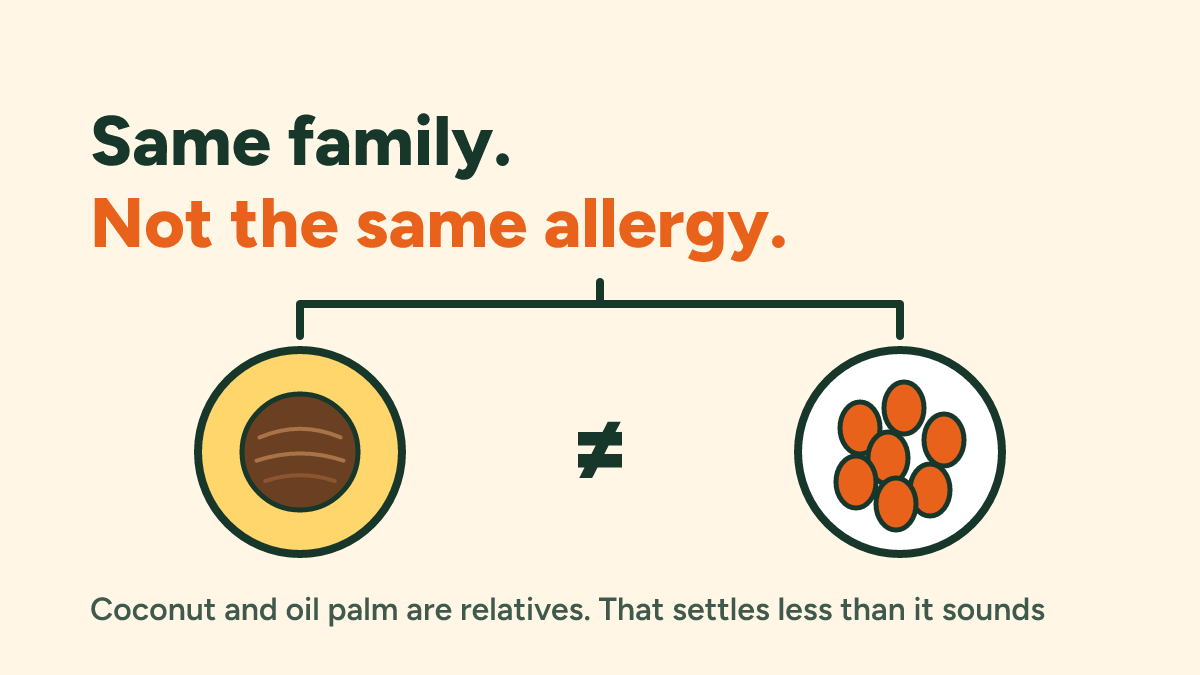
Coconut and oil palm are in the same plant family, and palm kernel oil is chemically close to coconut oil. But there is no published case of palm oil allergy, and nobody has tested whether the two cross-react. What that means for dates, açaí and the 'coconut or palm' on our product pages.
Published October 1, 2026 · 7 min read
Half the ingredients on this site are marked "coconut or palm". If you are allergic to coconut, the obvious next question is whether the palm half matters too.
The short answer: the two plants are relatives, and nothing we could find says that makes palm oil a problem. There is no published case of an allergy to palm oil or palm kernel oil, and the international allergen database lists no allergens from the oil palm at all [1]. Nor has anyone tested, in patients, whether coconut and oil palm cross-react. So: no evidence of a problem, and no study that went looking.
Why our pages say "coconut or palm"
Not because palm is a worry. Because the label can't tell them apart.
Many cosmetic ingredients can be made from either oil, and the name on the pack is the same both ways. When we mark a product "can't be verified", the uncertainty is about whether coconut is in it. Palm is the other possibility, the one that would make the answer no.
That is why a company's reply matters. If a brand tells us its glyceryl laurate comes from palm kernel, the question about coconut is closed. What we've asked, and who has answered.
How they are related
Both are palms, in the family Arecaceae, along with a good deal of what the tropics eat [2, 3]:
- Coconut (Cocos nucifera)
- Oil palm (Elaeis guineensis), the source of palm oil and palm kernel oil
- Date palm
- Açaí, and the hearts of palm cut from the same species
- Peach palm, eaten across Central America and Colombia as pixbae, pejibaye or chontaduro
- Babassu, whose oil is similar to coconut oil in its properties and uses
- Sago, palm sugar and betel nut
Being in the same family means shared ancestry. It doesn't by itself mean shared allergens, and that is the part that has to be tested rather than assumed.
Palm oil is not palm kernel oil
Two different oils come out of the same fruit, and they are not alike.
- Palm oil is pressed from the flesh. It is mostly palmitic acid, with almost no lauric acid: about 0.2% [4].
- Palm kernel oil is pressed from the seed. It is about 48% lauric acid [4], which is nearly the same as coconut oil at 45 to 50% [5].
That is the reason palm kernel oil stands in for coconut oil in soap and shampoo: to a chemist they are close to interchangeable. It is a statement about fat, though, not about protein, and allergy is about protein.
What the evidence says about palm oil
- No reported cases. A search of the medical literature found no published case of food allergy to palm oil or palm kernel oil.
- No registered allergens. The WHO/IUIS allergen database returns nothing for the oil palm [1].
- Refined oils in general. A study of refined vegetable oils concluded that the major ones, palm among them, do not provoke allergic reactions in susceptible people [6]. Its authors worked for a food manufacturer, which is worth knowing.
- What allergists say. Answering a question about coconut and palm oil for the AAAAI, an allergy specialist wrote that he could find no convincing case reports of reactions to either, and that palm oil is typically "not a concern" [7].
- The cautious note. Anaphylaxis UK points out that the effect of refining has only been researched for a few oils, and adds that refined plant oils in cosmetics are usually highly purified and unlikely to pose a risk [8].
The one hint the other way
In 2007 researchers studying two coconut-allergic patients identified a coconut allergen, a storage protein called a 7S globulin. When they compared a fragment of it against known proteins, the closest match was a 7S globulin from the oil palm [9].
That is a resemblance between two protein sequences, found from a short fragment in two patients. It is not a test of whether anyone reacts to both. No such test has been published. It is a reason for the question to be studied, and so far nobody has.
The other palms
Dates. Date fruit is a documented allergen in its own right [10]. On coconut and dates together we found one useful case: a child with coconut anaphylaxis who tested positive to date on the skin, and then ate dates without any reaction when challenged [11]. A positive test that turns out not to matter is common, and the testing guide explains why. We found no report of a real coconut–date cross-reaction.
Açaí, peach palm, babassu. Nothing in the literature, in either direction. Not reported is not the same as cleared; it means nobody has written it up.
Hearts of palm. One published case of a severe reaction, to the heart of a different palm species, with no link to coconut stated [12].
If one of these is a regular part of your diet and you have never had trouble, that is real information. If you have never eaten it, ask before you start.
Palm pollen is a different matter
Palms also cause hay fever where they grow. The pollens of several palms, coconut among them, share allergens with each other [13], and sensitisation to oil palm pollen has been measured at close to 10% in one recent study [14].
That is an airway allergy to pollen. The coconut pollen allergen is registered as exactly that [15], and we found no study of whether reacting to palm pollen predicts reacting to coconut as food. Living among palms and sneezing is not evidence of a food allergy.
What cross-reacts with coconut on better evidence
If you are asking what else to be careful with, palm is not at the top of the list. These are better documented:
- Walnut and hazelnut. Cross-reactions shown in individual patients [16, 17]. The same paper that reported the walnut link concluded there is no general reason to tell tree-nut-allergic people to avoid coconut [16].
- Lentil. Reported in a short published letter, linked to the same family of storage proteins [18].
- Macadamia. In a US children's study, the nut whose test results tracked most closely with coconut's [19]. That is testing positive to both, not proven cross-reaction.
All of these are things to raise with your allergist, with your own results in hand.
So, do you need to avoid palm?
Nothing we found says so. No allergy organisation advises it, no case has been reported, and the specialist opinion that exists calls palm oil not a concern.
What we can't tell you is that it has been studied and ruled out, because it hasn't. If you react to something whose only suspect ingredient is palm-derived, write it down and take it to your allergist. That would be worth knowing, for you and for everyone else.
Related
MCT oil · Is coconut a tree nut? · Where coconut hides · The complete guide
Sources
- WHO/IUIS Allergen Nomenclature database, search for Elaeis guineensis. allergen.org
- Encyclopaedia Britannica. “Palm.” britannica.com
- Encyclopaedia Britannica: Oil palm · Date palm · Açaí · Peach palm · Babassu palm · Arecales
- Mancini A. et al. “Biological and Nutritional Properties of Palm Oil and Palmitic Acid: Effects on Health.” Molecules, 2015. PMC
- Encyclopaedia Britannica. “Coconut oil.” britannica.com
- Crevel R.W., Kerkhoff M.A., Koning M.M. “Allergenicity of refined vegetable oils.” Food and Chemical Toxicology, 2000. PubMed
- AAAAI, Ask the Expert. “Coconut oil and palm oil with multiple food allergies.” aaaai.org
- Anaphylaxis UK. “Plant-based oils” factsheet, 2023. PDF
- Benito C., González-Mancebo E., de Durana M.D. et al. “Identification of a 7S globulin as a novel coconut allergen.” Annals of Allergy, Asthma & Immunology, 2007. PubMed
- Kwaasi A.A. et al. Allergy, 1999; 54: 1270–1277. PubMed
- Michavila Gómez A. et al. “Coconut anaphylaxis: case report and review.” Allergologia et Immunopathologia, 2015. elsevier.es
- Mayoral M. et al. Allergy, 2006; 61: 785–786. Wiley
- Chowdhury I. et al. Clinical & Experimental Allergy, 1998; 28: 977–983. PubMed
- Sio Y.Y. et al. “Sensitization to oil palm pollen associates with risks and severity of allergic diseases.” World Allergy Organization Journal, 2024. PMC
- WHO/IUIS Allergen Nomenclature database, Coc n 1. allergen.org
- Teuber S.S., Peterson W.R. Journal of Allergy and Clinical Immunology, 1999; 103: 1180–1185. PubMed
- Nguyen S.A., More D.R., Whisman B.A., Hagan L.L. “Cross-reactivity between coconut and hazelnut proteins in a patient with coconut anaphylaxis.” Annals of Allergy, Asthma & Immunology, 2004. PubMed
- Manso L. et al. “Cross-reactivity between coconut and lentil related to a 7S globulin and an 11S globulin.” Allergy, 2010. Wiley
- Kruse L., Lor J., Yousif R. et al. “Coconut allergy: characteristics of reactions and diagnostic predictors in a pediatric tertiary care center.” Annals of Allergy, Asthma & Immunology, 2021. PMC
Educational only, not medical advice. Always confirm with your allergist.