Is coconut a tree nut?
No. Coconut is a fruit, and since January 2025 the US FDA no longer counts it as a tree nut. Here is what that changes on labels, and what it doesn’t.
Published September 19, 2026 · 3 min read
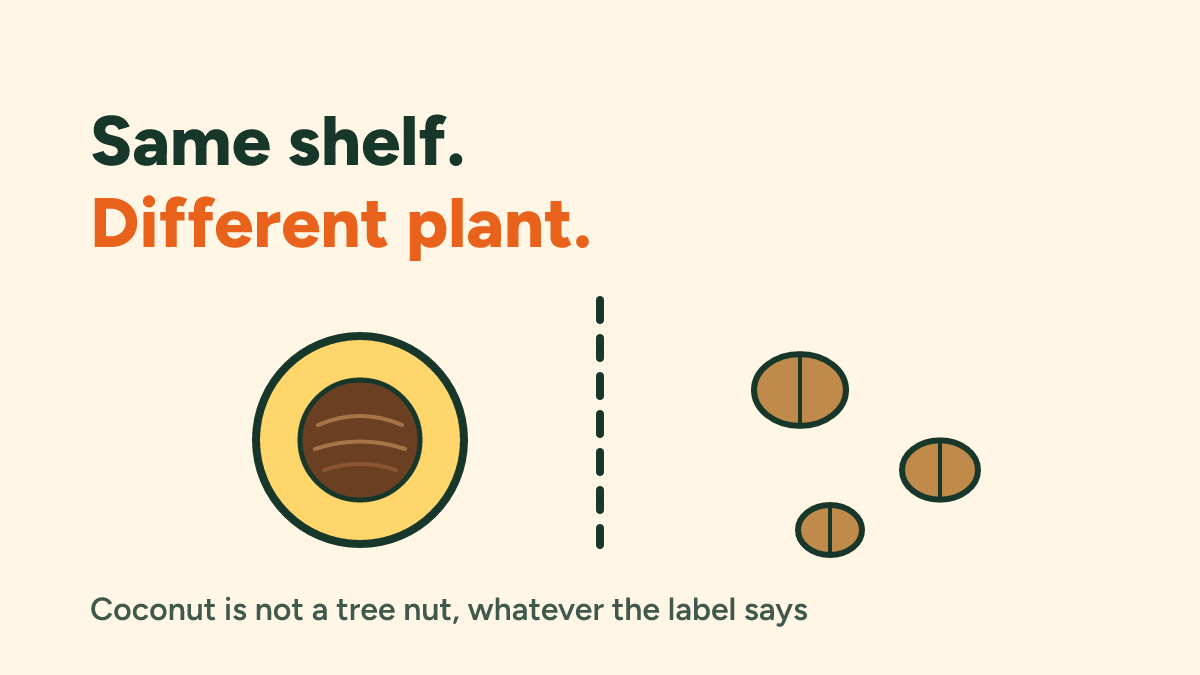
Short answer: no. Botanically, a coconut is a drupe: a fruit with a hard, stony shell, like a peach or an olive [1, 2]. For years the United States treated it as a tree nut on food labels, but that changed in January 2025.
What changed in the United States
In January 2025 the US Food and Drug Administration (FDA) published new allergen guidance (Edition 5) with a shorter list of tree nuts [3]. Coconut is no longer on it. The FDA confirms this in its questions-and-answers page [4].
What this means when you shop in the US:
- Coconut still has to appear in the ingredient list. It just no longer has to be called out as a major allergen in a “Contains:” statement [4].
- One exception: natural coconut flavor can be listed simply as “natural flavor” [4].
- You’ll see both styles for a while. There is no fixed deadline; companies can update labels the next time they print them, so “Contains: coconut” may keep appearing for a few years [4].
Europe and Latin America
- European Union: coconut is not one of the 14 allergens that must be highlighted on food labels. The EU “nuts” list names eight specific nuts, and coconut isn’t one of them [5].
- Brazil: coconut was proposed for the allergen list and was not added, because there wasn’t enough local data on how common or severe it is [6]. Companies may still declare it voluntarily.
- Mexico: the labeling standard (NOM-051) doesn’t mention coconut by name. Its tree-nut rule covers “all nuts produced by trees”, which leaves coconut open to interpretation [7].
So in most places, coconut won’t be highlighted as an allergen. You have to find it in the ingredient list yourself, often under a chemical name. That’s what the label checker and coconut’s names are for.
If you’re allergic to tree nuts, can you eat coconut?
Most people with a tree nut allergy can eat coconut without problems [1]. But the two allergies can overlap: in one hospital study, children allergic to coconut were often also sensitized to tree nuts, and most strongly to macadamia [8]. Ask your allergist before trying coconut, and don’t rely on a label that says “nut-free” to mean “coconut-free”.
So what do you actually check?
Whichever list a regulator puts coconut on, the only thing that protects you is the ingredient list itself. How to read a label takes about a minute, and the products we've checked may already have yours.
Sources
- ACAAI. “Tree Nut Allergy.” acaai.org (note: this page still describes the older FDA position)
- Anaphylaxis UK. “Seeds and foods with ‘nuts’ in the name” factsheet, 2023. PDF
- US FDA. “Questions and Answers Regarding Food Allergens, Including the Food Allergen Labeling Requirements of the Federal Food, Drug, and Cosmetic Act (Edition 5): Guidance for Industry.” January 2025. PDF
- US FDA. “Frequently Asked Questions: Food Allergen Labeling Guidance for Industry.” Updated March 2025. fda.gov
- Regulation (EU) No 1169/2011, Annex II. EUR-Lex
- Anvisa (Brazil). “Rotulagem de Alimentos Alergênicos: Perguntas e Respostas”, 6th edition, 2024. PDF
- Mexico. NOM-051-SCFI/SSA1-2010, modification published 27 March 2020. DOF
- Kruse L. et al. “Coconut allergy: Characteristics of reactions and diagnostic predictors in a pediatric tertiary care center.” Annals of Allergy, Asthma & Immunology, 2021. PMC
Educational only, not medical advice. Always confirm with your allergist.