How common is coconut allergy? The numbers, and how good they are
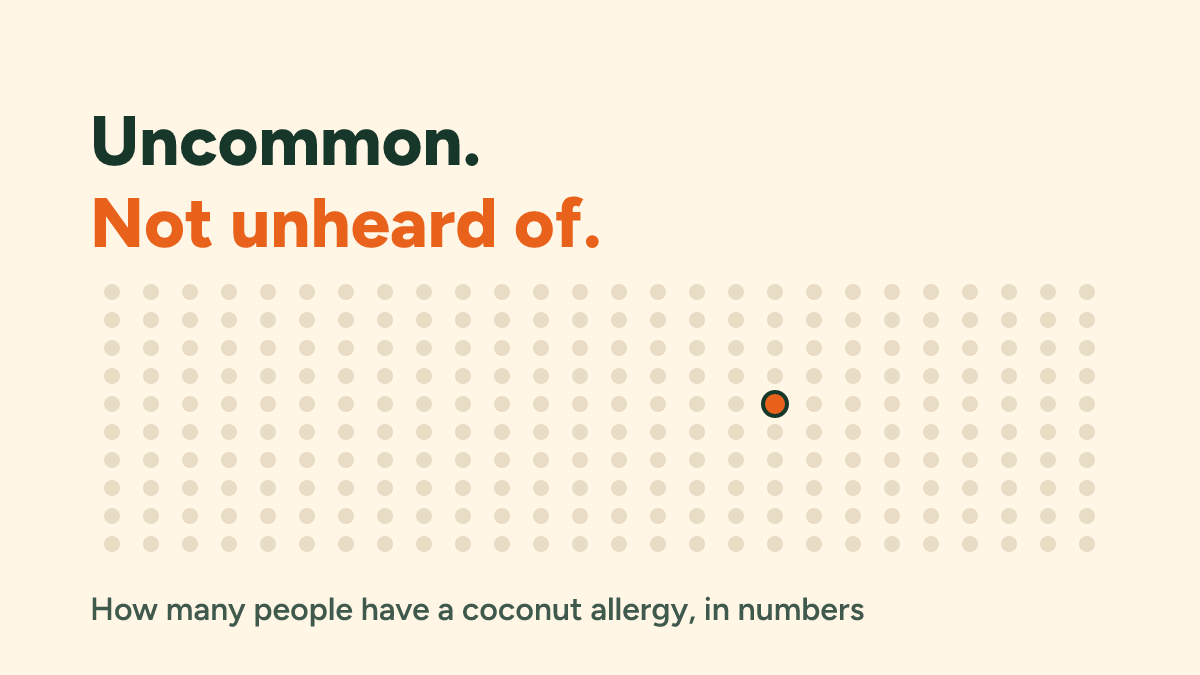
About 1 in 260 Americans reports symptoms that fit a coconut food allergy: roughly twice the adult figure for sesame in the same survey. How severe it is, when it starts, how often it is outgrown, how often patch tests find a coconut-derived allergen, and how little is known outside the United States.
Published October 1, 2026 · 7 min read
Coconut allergy is usually described as rare. That is true compared with peanut or milk. It is less true than most people assume, and the numbers behind the word "rare" are thin enough that it is worth knowing where each one comes from.
The one population figure
There is one survey of the general population, and it is American. Researchers asked about food allergies in more than 78,000 people in 2015 and 2016, and published the coconut results in 2023 [1].
| All ages | Children | Adults | |
|---|---|---|---|
| Said they had a coconut allergy | 0.73% | 0.47% | 0.81% |
| Described symptoms that fit a true food allergy | 0.39% | 0.22% | 0.43% |
| Fit, and had a doctor's diagnosis | 0.18% | 0.12% | 0.20% |
The middle row is the "about 1 in 260" you will see quoted. The top row is more than 2 million people who believe they are allergic to coconut.
Two things to know about it:
- It is self-reported. People described their reactions, and the researchers judged whether the symptoms fitted. Fewer than half of the people in the middle row, 46%, had been diagnosed by a doctor [1].
- It was funded in part by a coconut industry group, alongside the US National Institutes of Health [1]. That is in the paper's own funding statement.
Compared with the allergens that get labelled
The same survey, with the same method, produced the figures for the major allergens in adults [1, 2]:
| Allergen | Adults affected |
|---|---|
| Shellfish | 2.9% |
| Milk | 1.9% |
| Peanut | 1.8% |
| Tree nuts | 1.2% |
| Fish | 0.9% |
| Coconut | 0.43% |
| Sesame | 0.2% |
Sesame became the ninth major allergen in US law in 2023, and has to be declared wherever it is used [3]. On these figures coconut is about twice as common among adults. Since January 2025 it doesn't have to be declared in an allergen statement at all [4]. What changed.
How serious it is
In the survey [1], among people whose symptoms fitted:
- 48% had reactions involving more than one part of the body
- 16% had wheezing, fainting or low blood pressure
- 40% currently had adrenaline prescribed, and 21% had used an auto-injector for a coconut reaction
The commonest symptoms were hives (56%), itching (54%) and rash (42%). Throat tightening was reported by 22% and trouble breathing by 20%.
In hospital clinics the picture depends on the clinic:
- Chicago, 69 children with a reaction: about half the reactions from eating coconut were classed as mild or moderate anaphylaxis, and none as severe [5]
- Singapore, 41 children: 10% had anaphylaxis [6]
- Australia and Thailand: about a quarter, as reported by the Singapore authors [6]
What a reaction looks like, and when to call for help.
When it starts
- In children, early. In Singapore the typical age at first reaction was 20 months, and 80% reacted the first time they ate it [6]. In Chicago the average was 5 years [5].
- In adults too. Among adults in the survey, 22% said theirs began in adulthood [1]. Becoming allergic as an adult.
How it happened, in the Chicago children: 83% by eating, 14% by skin contact, and two babies through breast milk [5].
Does it go away?
The answers don't agree.
- In the US survey, 25% of people who had ever had a coconut allergy said they had outgrown it. Among children under 10, it was 38% [1].
- In Singapore, 1 child of 41 was known to have outgrown it, over a typical follow-up of about three years. The authors say that may be an underestimate, because they didn't test for it [6].
- In Chicago, tolerance was confirmed by a supervised challenge in one patient [5].
The honest reading is that some people do outgrow it, and nobody has followed a group of patients for long enough, with proper challenges, to say how many.
A positive test is not a diagnosis
The Chicago study began with 275 children who had tested positive for coconut. Only 69 of them, a quarter, had ever reacted. Nine had eaten coconut without trouble; the rest had never knowingly eaten it [5].
That is why "sensitised" and "allergic" are different words. What each test can tell you.
It rarely comes alone
In the survey, 70% of people with a coconut allergy had at least one other food allergy. Peanut was the commonest (28%), then tree nuts (20%) and milk (18%). Asthma was more than twice as common as in the general population, 30% against 12% [1].
That is company, not cause. What cross-reacts with coconut, and what doesn't.
Outside the United States
We looked for a population figure from anywhere else and found none.
- Europe: a 2024 review of food allergies beyond the main eight, pooling European studies, does not mention coconut once [7].
- United Kingdom: Anaphylaxis UK calls it rare and says no precise statistics are available [8].
- Everywhere else: hospital case series. 41 children in Singapore [6], 35 in Australia and 11 in Thailand [6], 18 patients in Sri Lanka [9]. A 2015 review from Spain counted nine cases in the medical literature in total [10].
For Latin America, where coconut is everyday food on the Caribbean coast, we found nothing at all.
So the only population figure there is comes from a country where coconut is not a staple.
The other coconut allergy
Everything above is about food. The contact allergy, to cleansers made from coconut, is counted differently: among people sent for patch testing because of a rash, how many react?
From the North American patch-test group, 10,877 patients tested between 2009 and 2014 [11]:
| Allergen | Positive |
|---|---|
| Oleamidopropyl dimethylamine | 2.3% |
| DMAPA, an impurity in cocamidopropyl betaine | 1.7% |
| Cocamidopropyl betaine | 1.4% |
| Amidoamine, another impurity | 0.8% |
| Cocamide DEA | 0.8% |
And for the "gentle" plant-based cleansers, decyl and lauryl glucoside: 2.0% of 24,097 patients, with most of those reactions judged relevant to the patient's current rash [12].
These are percentages of people already being investigated for a rash, not of everyone. What the patch tests pick up is the manufactured chemical, or an impurity in it; none of these studies is about coconut protein. Australia's allergy society says contact dermatitis from coconut products is more common than food allergy to coconut [13]. The two kinds of coconut allergy.
What the numbers add up to
- It is uncommon, and on the only population data there is, more common than one allergen the law requires on every label.
- Most of what is known comes from one survey and a handful of children's hospitals.
- Fewer than half of the people who report it have been diagnosed.
If you have it, you are not as alone as "rare" makes it sound. You are under-counted.
Related
The complete guide · Symptoms · Cross-reactivity · How it is diagnosed · Is coconut a tree nut?
Sources
- Warren C.M., Sehgal S., Nimmagadda S.R., Gupta R. “Prevalence and burden of coconut allergy in the United States.” Annals of Allergy, Asthma & Immunology, 2023; 131(5): 645–654. PMC
- Gupta R.S., Warren C.M., Smith B.M. et al. “Prevalence and Severity of Food Allergies Among US Adults.” JAMA Network Open, 2019. PMC
- US FDA. “Food allergies.” fda.gov
- US FDA. “Frequently Asked Questions: Food Allergen Labeling Guidance for Industry.” fda.gov
- Kruse L., Lor J., Yousif R. et al. “Coconut allergy: characteristics of reactions and diagnostic predictors in a pediatric tertiary care center.” Annals of Allergy, Asthma & Immunology, 2021. PMC
- Tan L.L., Goh S.H., Lee M.P. et al. “IgE-mediated coconut allergy in tropical Singapore.” Asia Pacific Allergy, 2025. PMC
- Spolidoro G.C.I. et al. “Food allergy outside the eight big foods in Europe: a systematic review and meta-analysis.” Clinical and Translational Allergy, 2024. PMC
- Anaphylaxis UK. “Coconut allergy” factsheet, 2019. PDF
- Dissanayake S. et al. Study of coconut milk allergy in Sri Lanka, 2022. PMC
- Michavila Gómez A. et al. “Coconut anaphylaxis: case report and review.” Allergologia et Immunopathologia, 2015. elsevier.es
- Fowler J.F. et al. North American Contact Dermatitis Group data on surfactants, 2009–2014. Dermatitis, 2015; 26(6): 268–270. PubMed
- Warshaw E.M. et al. North American Contact Dermatitis Group data on glucosides, 2009–2018. Journal of the American Academy of Dermatology, 2022; 87(5): 1033–1041. PubMed
- ASCIA. “Coconut allergy.” Updated April 2024. allergy.org.au
Educational only, not medical advice. Always confirm with your allergist.