Coconut allergy cross-reactivity: tree nuts, lentils, latex, pollen and palms
If you are allergic to coconut, what else might you react to? What has actually been shown for walnut, hazelnut, macadamia and almond, lentils and chickpeas, buckwheat, latex, coconut pollen and other palms: how many patients, and whether it was a reaction or only a blood test.
Published October 1, 2026 · 8 min read
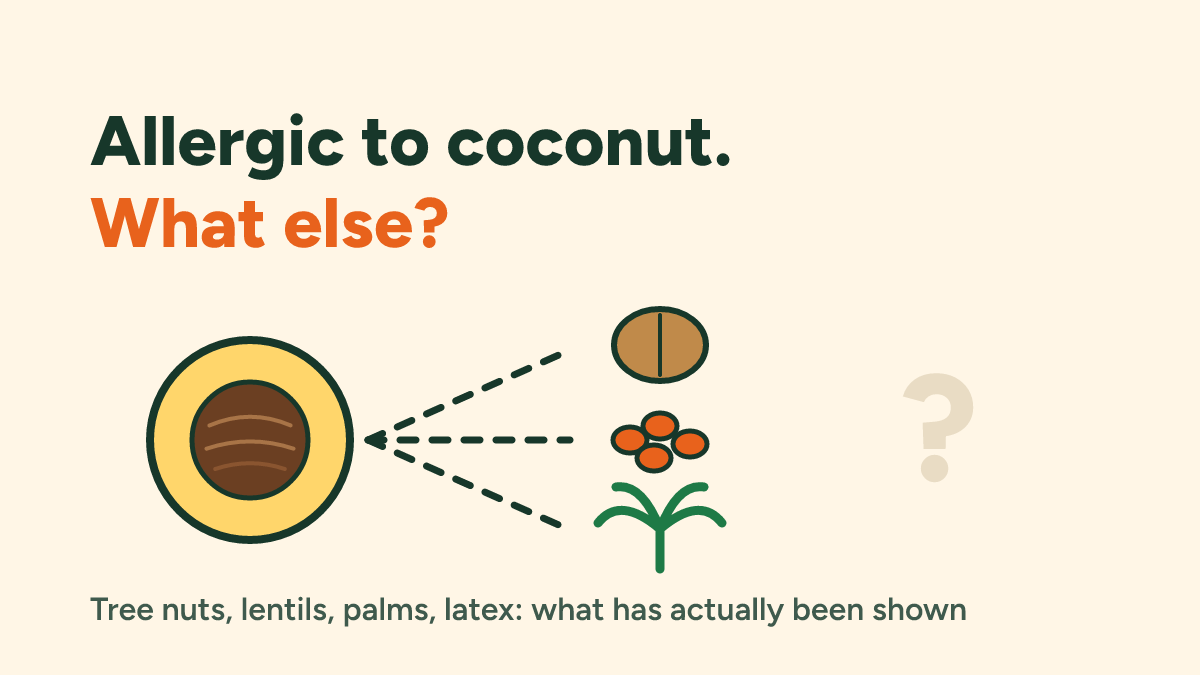
Lists of "foods that cross-react with coconut" get copied from site to site: walnut, hazelnut, lentil, latex. Each of those words traces back to a real paper. When you open the papers, most of them describe one or two people.
The short answer: nothing follows automatically from a coconut allergy. People with it often have other food allergies, and often test positive to tree nuts. Proven cross-reactions, where the same antibody recognises both foods and the person reacts to both, have been shown in a handful of patients.
Don't stop eating a food you eat without trouble because of this page, or any list.
Three different things
They get mixed up constantly, and the difference is the whole subject.
- Co-allergy. You are allergic to two foods. Common in anyone with food allergies.
- Co-sensitisation. A blood or skin test is positive to both. It says nothing about whether you react.
- Cross-reactivity. The same antibody binds a similar protein in both foods. It is shown in a laboratory, by testing whether one food blocks the antibody's binding to the other.
Only the third is a statement about the foods. The first two are statements about the person.
Tree nuts
What has been shown in patients:
| Study | Who | What was found |
|---|---|---|
| 1999 [1] | 2 people with tree-nut allergy who later reacted to coconut | Antibodies that bound coconut were blocked by walnut. The authors concluded that there is no general reason to tell people with tree-nut allergy to avoid coconut. |
| 2004 [2] | 1 patient with anaphylaxis to coconut and mouth symptoms with tree nuts | Coconut completely blocked binding to hazelnut; hazelnut only partly blocked binding to coconut |
| 2007 [3] | 2 patients; one a child with walnut allergy and anaphylaxis to coconut | Cross-reactivity among coconut, walnut and hazelnut in the child only |
That is five people in three papers, and it is the evidence behind "coconut cross-reacts with walnut and hazelnut".
What larger groups show:
- Boston, 40 children tested for coconut. No significant link between being sensitised or allergic to peanut or tree nuts and being sensitised or allergic to coconut. No child reacted to peanut, tree nuts and coconut [4].
- Kansas City, 298 blood tests. Coconut results tracked most closely with macadamia, then almond. That was a study of test results, with no reactions assessed [5].
- Chicago, 275 children positive to coconut. Coconut antibody levels correlated with those for macadamia, almond, Brazil nut, pecan and hazelnut. The authors point out that this doesn't mean the children react to those nuts, and recommend that coconut should not be part of tree-nut test panels [6].
How many people with a coconut allergy also have a tree-nut allergy? In the US population survey, 20%: 40% of the children and 17% of the adults. Peanut was more common still, at 28%, and 70% had more than one food allergy of some kind [7]. In a Singapore clinic, 49% were allergic or sensitised to a tree nut and 51% to peanut; the authors read that as a general tendency to food allergy and say they can't conclude there is a link [8].
Peanut is the useful comparison. It is the commonest companion allergy, and nobody thinks coconut and peanut cross-react: the Chicago study found no significant correlation between the two [6].
What the allergy organisations say, and they agree:
- ASCIA (Australia): coconut is very different from peanuts and tree nuts. A few of the reported cases were in people also allergic to walnut or hazelnut; others were allergic to coconut alone [9].
- Anaphylaxis UK: people with tree-nut allergy can generally tolerate coconut, with rare exceptions [10].
- ACAAI (US): most people allergic to tree nuts can eat coconut; ask your allergist first [11].
- AAAAI (US): the risk is increased, but probably only slightly [12].
- Food Allergy Canada: coconut is not usually restricted for people with tree-nut allergy [13].
All of those are written for people with a nut allergy asking about coconut. The reverse question, coconut first, has no official answer that we could find. The sensible reading of the evidence is the same in both directions: ask to be tested, and judge by what happens when you eat the food, not by the test alone.
A test to know about
Anaphylaxis UK warns that one widely used mixed-nut blood test includes coconut in the mix, and that a positive result is sometimes wrongly read as a coconut allergy [10]. If your diagnosis came from a "nut mix" panel, ask which individual foods were tested.
Lentils, chickpeas and other legumes
The claim that coconut cross-reacts with lentil comes from a single letter published in 2010, from Spain, attributing it to two storage proteins the foods have in common [14]. It has no abstract and we could not read the full text, so we can't tell you how many patients it describes.
Around it:
- In Chicago, coconut antibody levels correlated with those for chickpea, soy and lentil. Small numbers, test results only [6].
- In Sri Lanka, 4 of 18 patients allergic to coconut milk were also allergic to a legume [15].
Enough to mention to your allergist if lentils or chickpeas have ever given you symptoms. Not enough to avoid them.
Buckwheat
One letter, 2015 [16]. We could not read it in full; a laboratory reference guide summarises it as cross-reactivity between a coconut protein and a buckwheat protein of the same family [21]. Buckwheat is not wheat; it is the seed in soba noodles and some gluten-free flours.
Latex
This one is weaker than the lists suggest.
- The source is a 1999 study of 137 people with latex allergy. Asked about food reactions, one of them named coconut [17]. Nothing was tested in the laboratory.
- In the US survey, 9.5% of people with a coconut allergy also reported a latex allergy, against 2% of the population. But the figure for people with any of the major food allergies was 6.3%, which is not meaningfully different [7].
We found no laboratory evidence that coconut and latex share an allergen.
Coconut pollen
A surprise in the official record: the international allergen database lists exactly one coconut allergen, Coc n 1, and it is a pollen allergen, identified in people in India with hay fever and asthma [18]. The proteins researchers blame for the food allergy have not been registered.
In studies from India, coconut pollen is among the pollens that allergy patients most often test positive to [19]. Whether being allergic to the pollen makes you more likely to react to the food, nobody has tested.
Other palms
Coconut's nearest relatives are covered on their own page: coconut and palm oil. In brief: one coconut allergen resembles a protein from the oil palm [3], there is no published case of palm oil allergy, and we found nothing either way on dates or açaí. One coconut-allergic child in the Spanish report was sensitised to dates and ate them without trouble [20].
What didn't show a link
- Peanut: no association in Boston [4], no correlation in Chicago [6].
- Sesame: no association in Boston [4]. Test results correlated in Chicago [6]; no laboratory study of cross-reactivity exists.
- Mustard: nothing published.
Why the same proteins keep coming up
Seeds store protein for the plant that will grow from them, and many seeds use the same two families of storage protein, called 7S and 11S globulins. Coconut has both, and the papers above point to the same families in walnut, hazelnut, soy, lentil and buckwheat [1, 3, 14, 21].
Similar proteins make cross-reaction possible. They don't make it likely.
What to do with this
- Keep eating what you eat without trouble.
- Tell your allergist about any food that has given you symptoms, particularly walnut, hazelnut, macadamia, almond, lentil or chickpea.
- Treat a positive test as a question. A positive test for a nut you have always eaten without trouble is sensitisation. What tests can and can't tell you.
- If you already have a tree-nut allergy and are wondering about coconut, the organisations above all say the same thing: most people can eat it, and ask first.
Related
Is coconut a tree nut? · Coconut and palm oil · How coconut allergy is diagnosed · How common is coconut allergy? · The complete guide
Sources
- Teuber S.S., Peterson W.R. Journal of Allergy and Clinical Immunology, 1999. PubMed
- Nguyen S.A. et al. Annals of Allergy, Asthma & Immunology, 2004. PubMed
- Benito C. et al. Identification of a coconut allergen in two patients, 2007. PubMed
- Stutius L.M. et al. “Characterizing the relationship between sesame, coconut, and nut allergy in children.” Pediatric Allergy and Immunology, 2010. PMC
- Polk B.I. et al. Annals of Allergy, Asthma & Immunology, 2016. PubMed
- Kruse L., Lor J., Yousif R. et al. “Coconut allergy: characteristics of reactions and diagnostic predictors in a pediatric tertiary care center.” Annals of Allergy, Asthma & Immunology, 2021. PMC
- Warren C.M., Sehgal S., Nimmagadda S.R., Gupta R. “Prevalence and burden of coconut allergy in the United States.” Annals of Allergy, Asthma & Immunology, 2023. PMC
- Tan L.L., Goh S.H., Lee M.P. et al. “IgE-mediated coconut allergy in tropical Singapore.” Asia Pacific Allergy, 2025. PMC
- ASCIA. “Coconut allergy.” Updated April 2024. allergy.org.au
- Anaphylaxis UK. “Coconut allergy” factsheet, 2019. PDF
- American College of Allergy, Asthma and Immunology. “Tree nut.” acaai.org
- AAAAI, Ask the Expert. “Reaction to coconut.” Updated December 2023. aaaai.org
- Food Allergy Canada. “Tree nuts.” foodallergycanada.ca
- Manso L. et al. “Cross-reactivity between coconut and lentil related to a 7S globulin and an 11S globulin.” Allergy, 2010. PubMed
- Dissanayake S. et al. Study of coconut milk allergy in Sri Lanka, 2022. PMC
- Cifuentes L. et al. Annals of Allergy, Asthma & Immunology, 2015. PubMed
- Kim K.T., Hussain H. Allergy and Asthma Proceedings, 1999. PubMed
- WHO/IUIS Allergen Nomenclature database, Cocos nucifera. allergen.org
- Singh A.B., Shahi S. Review of airborne pollen allergens in India, 2008. PubMed · Skin-test study of atopic patients in West Bengal, 2018. PubMed
- Michavila Gómez A. et al. “Coconut anaphylaxis: case report and review.” Allergologia et Immunopathologia, 2015. elsevier.es
- Thermo Fisher Scientific. Allergen encyclopedia, “f36 Coconut”, reviewed November 2020. thermofisher.com
Educational only, not medical advice. Always confirm with your allergist.