Shredded and desiccated coconut allergy: the dried flesh, the sweets it is in, and the sulphites
Shredded coconut is the flesh with the water taken out, so weight for weight it carries about twice the protein of fresh coconut. What the case reports show, why toasting and baking settle nothing, the cereals, bars and curry pastes that list it, the sweets made of it in Spanish-speaking countries, and the sulphites that are often added to keep it white.
Published October 2, 2026 · 9 min read · How these guides are made
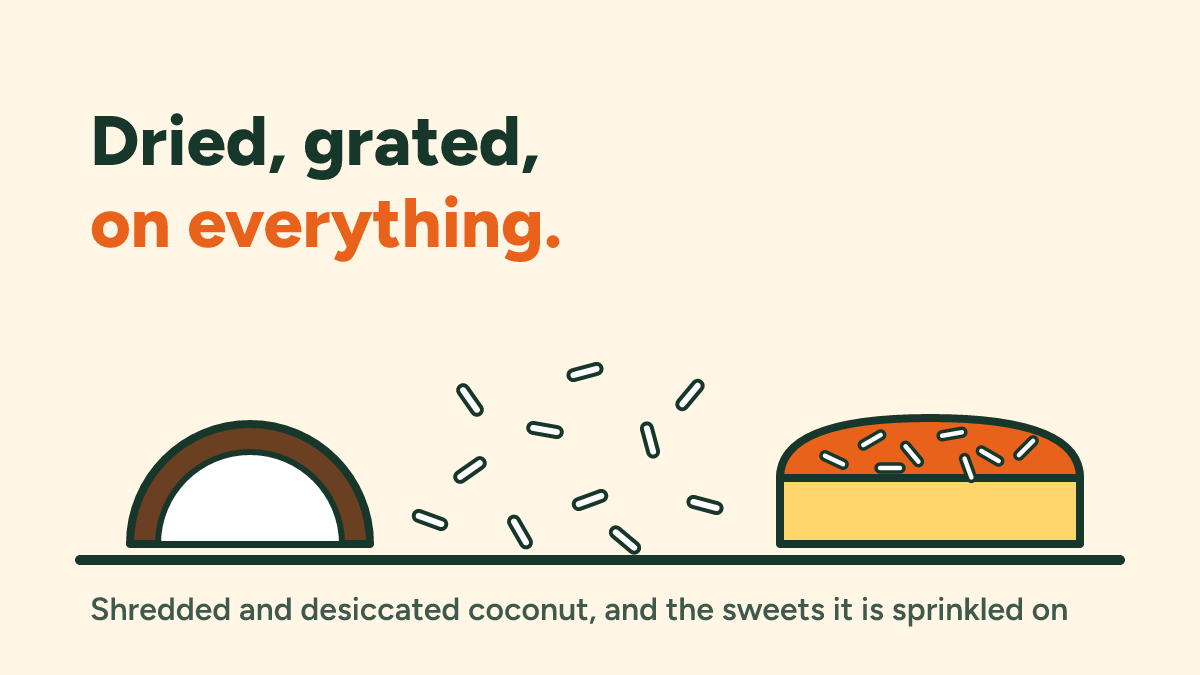
Shredded, desiccated, flaked, grated: it is all the same thing. The white flesh of the coconut, cut small and dried.
The short answer: if you are allergic to coconut as a food, this is the coconut itself with the water taken out. Weight for weight it has about twice the protein of fresh coconut, and it is sprinkled on or baked into things that don't always have coconut in their name. And if you reacted to shredded coconut but have never been sure coconut was the reason, there is often a second suspect on the same label: sulphites.
What it is
The international food standard defines desiccated coconut as the sound white kernel of the coconut, husked, pared, washed, cut up, dried and sifted, with no more than 4% water left in it. Flakes, chips and shreds are the same product in different cuts. The standard covers only the plain kind: nothing salted, sweetened, flavoured or roasted [1].
The names you will meet:
| On the label | What it is |
|---|---|
| Desiccated coconut | The dried flesh, usually finely grated. The usual name in the UK, Australia and on ingredient lists |
| Shredded coconut, coconut flakes, coconut chips | The same, in longer or wider cuts |
| Toasted or roasted coconut | The same, browned |
| Sweetened coconut flakes | The US baking-aisle kind. One of the best known lists coconut, sugar, water, propylene glycol, salt and sodium metabisulfite [2] |
| Coco rallado, coco deshidratado, coco seco | The Spanish names |
| Copra | The dried kernel used for pressing oil [7] |
How much coconut is in it
An allergy to a food is an allergy to its protein, so the useful number is protein per 100 g [3].
| Form | Protein per 100 g |
|---|---|
| Desiccated coconut, unsweetened | 6.9 g |
| Desiccated, toasted | 5.3 g |
| Fresh coconut flesh | 3.3 g |
| Sweetened shredded coconut | 2.9 g |
| Coconut milk, canned | 2.0 g |
| Coconut water | 0.7 g |
Drying takes out the water and leaves everything else, which is why the plain dried kind has about twice the protein of the fresh flesh. The sweetened kind has less only because part of its weight is sugar and water.
The doctors behind the largest series of coconut-allergic children, in Singapore, think the amount of protein is the most likely reason some forms of coconut cause reactions more often than others [4]. The one form more concentrated than this is coconut flour, at 16 g.
What the reports show
- Singapore, 41 children. For 6 of them, about 1 in 7, desiccated coconut was the first coconut food they reacted to. Only coconut milk was the first trigger more often [4].
- Tenerife, one adult. Her first reaction came straight after eating grated coconut: a hoarse voice, difficulty breathing and itching of the palms and soles. She went on to have anaphylaxis [5].
- United States, one child. The child ate an oatmeal and raisin cookie that also contained coconut and got an itchy throat. Later, at school, the child ate another by mistake, and this time vomited and wheezed [6].
The cookie matters. Dried coconut is an ingredient people don't see: it is small, pale, and disappears into oats.
We looked for two things and did not find them: any report of reactions from breathing in coconut dust in a bakery or factory, and any study comparing fresh and dried coconut in the same patients.
Toasting and baking settle nothing
It is tempting to think that a toasted flake or a baked macaroon is somehow weaker. Nobody has tested that.
The only study of heat and coconut allergens used coconut milk, heated to 70 °C for fifteen minutes. Nine of the twelve allergens were still there afterwards, and the researchers concluded that it stays allergenic after boiling [7]. No one has done the same with toasted or baked dried coconut. What can be said is that toasted desiccated coconut still has 5.3 g of protein per 100 g [3].
So "it was baked" is not a reason to try it.
The second suspect: sulphites
Dried coconut browns with time. To keep it white, many producers add a sulphite.
- Baker's Angel Flake (US): sodium metabisulfite, which the label says "retains coconut whiteness" [2].
- Whitworths Desiccated Coconut (UK): preservative, sulphur dioxide [8].
- Nuts.com Tropical Mix: coconut chips made of coconut and sodium metabisulfite [8].
- Not all of them. Bob's Red Mill describes its shredded coconut as unsweetened and unsulfured [8].
The food standard allows the preservatives permitted for dried fruit [1], and the European additive rules list sulphites for dried coconut, up to 50 mg per kg [9].
This matters because sulphites cause reactions of their own. Australia's allergy society says asthma symptoms are the commonest: wheezing, a tight chest and a cough, in about 5 to 10% of people who have asthma. It describes most of these reactions as an intolerance and not an allergy, and notes that they can be confused with one [10].
Unlike coconut, sulphites have to be declared. They are one of the 14 allergens that European labels must highlight when there is more than 10 mg per kg [11], and US rules require them on the label from 10 parts per million [11].
What to do with that:
- If shredded coconut has made you wheeze, but coconut milk in a curry never has, tell your allergist both facts. It is the kind of detail that changes which tests are worth doing.
- If you are allergic to coconut, an "unsulfured" pack changes nothing. The coconut is still coconut.
Where it turns up
Some are obvious: macaroons, Bounty bars [12], coconut shrimp. One frozen coconut shrimp we read lists both coconut and sodium bisulfite [13].
Others have nothing in the name. These are labels read on the makers' or sellers' own pages on 2 October 2026 [13]:
| Product | What the ingredient list says |
|---|---|
| Kellogg's Cracklin' Oat Bran (cereal, US) | Whole grain oats, sugar, wheat bran, palm oil, oat bran, corn syrup, wheat starch, coconut |
| Eat Natural protein bar with peanuts and chocolate (UK) | Desiccated coconut (7.5%) |
| Tunnock's Caramel Log (UK) | A wafer and caramel biscuit "sprinkled with roasted coconut" |
| Patak's Korma spice paste (UK) | Desiccated coconut (3%) |
| Nuts.com Tropical Mix (US) | Unsweetened coconut chips |
The pattern to remember is the category, not the brand: granola and oat cereals, cereal and protein bars, biscuits with a coating, curry pastes, trail mixes, carrot cake and anything with a pale sprinkle on top. One maker of shredded coconut suggests exactly those uses on its own page: macaroons and carrot cake muffins [8].
In Spanish-speaking countries
Here dried coconut is less of a hidden ingredient and more of a main one, in sweets that are sold loose, with no label at all.
- Cocadas. The Spanish dictionary defines a cocada as a sweet made mainly of grated coconut [14].
- Alfajores de maicena (Argentina, Uruguay). Two soft biscuits filled with dulce de leche, with the edge rolled in grated coconut. A standard recipe uses 100 g of it [14].
- Sultanas de coco, or coquitos (Spain). Little baked mounds that are mostly coconut: 250 g of it to five egg whites in a typical recipe [14].
And beyond these: besitos de coco, coconut panellets, and the grated coconut that street stalls and bakeries dust over cakes, doughnuts and fruit.
Where there is no label
A bakery counter, a market stall and a restaurant dessert carry no ingredient list. In the UK and the European Union, caterers only have to be able to tell you about the 14 listed allergens, and coconut is not one of them [11, 12]. So the question has to be asked by name: Anaphylaxis UK's advice is to make sure the staff understand that it is coconut you must avoid [12].
On the label
- United States. Since January 2025 coconut is no longer on the FDA's list of tree nuts, so it does not have to appear in a "Contains" statement. It still has to be in the ingredient list [15]. Some packs still say "Contains: coconut", because old labels are allowed to run out. The Baker's and coconut shrimp labels we read both still do [2, 13].
- Europe. Coconut is not one of the 14 allergens, so it is never in bold. It is in the ingredient list, in ordinary type [11].
- The words to look for: coconut, desiccated coconut, shredded coconut, coconut flakes, coconut chips, toasted coconut, coco rallado, coco deshidratado.
How to read a label for coconut · Candy and chocolate
If you tolerate one form, do you tolerate the others?
There is no rule.
An allergist answering this question for the American Academy of Allergy described a patient who tolerates coconut water and reacts to other parts of the coconut. The answer given is that the amount of protein eaten is the main thing that decides a reaction, and that reactions are still unpredictable [16]. In Singapore, most children reacted to coconut milk or flesh, and fewer than 15% to coconut water or oil [4].
So tolerating a food cooked in refined coconut oil tells you very little about a macaroon. The only way to find out what you tolerate is a supervised test with an allergist, not a trial at home.
Coconut oil · Coconut milk · Coconut water
What to do with this
- Treat dried coconut as the concentrated form. It is more coconut per bite than the fresh flesh, not less.
- Read the cereal, the bar and the curry paste. Those are the ones without coconut in the name.
- Ask about the sprinkle. At a bakery or a stall, ask what is on top and what is in the filling, and say the word coconut.
- Don't count on toasting or baking.
- If your only reactions were to shredded coconut, mention the sulphites to your allergist.
Related
Foods to avoid · Coconut sugar, flour and aminos · Candy and chocolate · Eating out · Treatment · The complete guide
Sources
- Codex Alimentarius. Standard for desiccated coconut (CXS 177-1991). PDF
- Baker's Angel Flake Sweetened Coconut, ingredient list on a retailer's page, read 2 October 2026. lundsandbyerlys.com
- USDA FoodData Central: desiccated, unsweetened · desiccated, toasted · sweetened, shredded · raw flesh · coconut milk, canned · coconut water
- Tan L.L., Goh S.H., Lee M.P. et al. “IgE-mediated coconut allergy in tropical Singapore.” Asia Pacific Allergy, 2025. PMC
- Hernández-Santana G.L. et al. “Induction of Oral Tolerance in a Case of Severe Allergy to Coconut.” Journal of Investigational Allergology and Clinical Immunology, 2019; 29(5): 380–381. PDF
- Anagnostou K. “Coconut Allergy Revisited.” Children, 2017. PMC
- Iddagoda J. et al. “Identification of allergens in coconut milk and oil with patients sensitized to coconut milk in Sri Lanka.” Clinical and Molecular Allergy, 2022. PMC
- Makers' pages, read 2 October 2026: Whitworths Desiccated Coconut · Nuts.com Tropical Mix · Bob's Red Mill Shredded Coconut
- Commission Regulation (EU) No 1129/2011, annex, food category 04.2.1. legislation.gov.uk
- ASCIA (Australasian Society of Clinical Immunology and Allergy). “Sulfite sensitivity”, updated August 2024. allergy.org.au
- Regulation (EU) No 1169/2011, Annex II. legislation.gov.uk · US Code of Federal Regulations, 21 CFR 101.100(a)(4). ecfr.gov
- Anaphylaxis UK. “Coconut allergy” factsheet, 2019. PDF
- Ingredient lists read 2 October 2026: Kellogg's Cracklin' Oat Bran · Eat Natural · Tunnock's Caramel Log · Patak's Korma paste · SeaPak Jumbo Coconut Shrimp (retailer's page)
- Real Academia Española. Diccionario de la lengua española, “cocada”. dle.rae.es · Cocineros Argentinos. “Alfajores de maicena.” cocinerosargentinos.com · Divina Cocina. “Sultanas de coco.” divinacocina.es
- US FDA. “Frequently Asked Questions: Food Allergen Labeling Guidance for Industry.” fda.gov
- AAAAI, Ask the Expert. “Coconut.” November 2025. aaaai.org
Educational only, not medical advice. Always confirm with your allergist.