Being ready for a reaction: adrenaline, action plans and medical ID
What to do in a severe allergic reaction, whether you can buy an adrenaline auto-injector without a prescription where you live, how to carry and store it, where to get a written action plan, and how to make sure a stranger knows what you are allergic to.
Published October 1, 2026 · 6 min read
If you think it is anaphylaxis:
- Lie down. Don't stand or walk.
- Use the adrenaline (epinephrine). Don't wait to see if it passes.
- Call the emergency number and say "anaphylaxis".
- No better after 5 minutes? Use a second device if you have one.
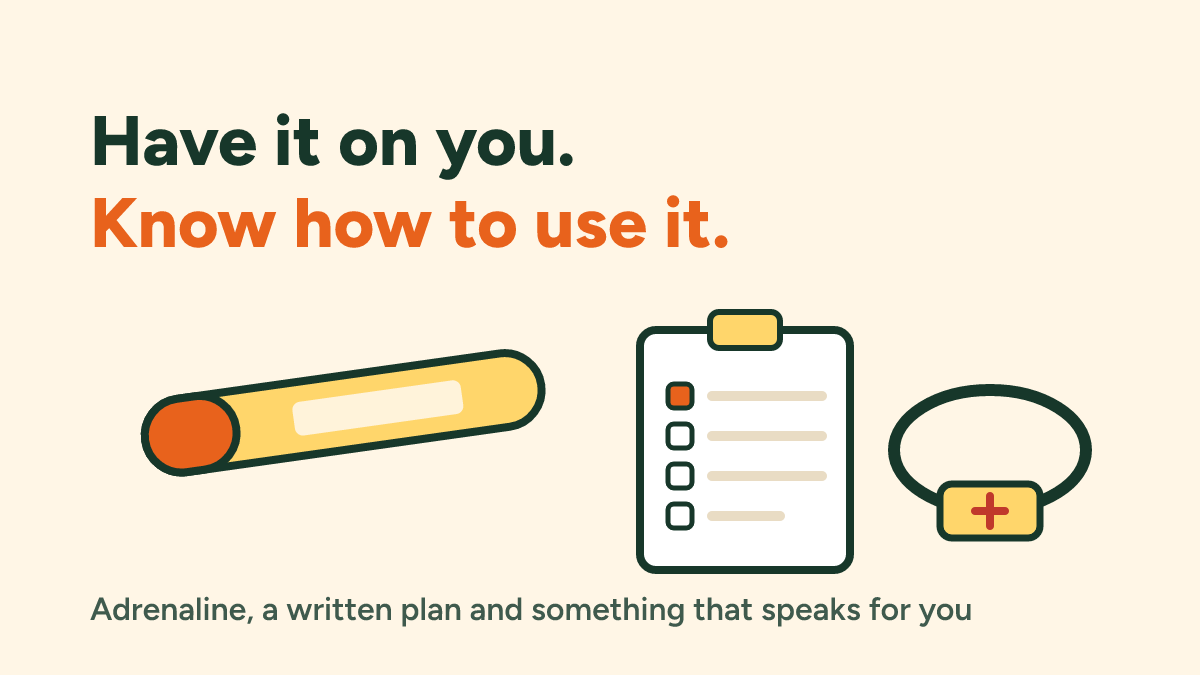
Avoiding coconut is most of living with this allergy. The rest is being ready for the day avoiding it fails. That comes down to three things: the medicine, a plan somebody else can follow, and a way for a stranger to know what is wrong with you.
Nothing here is specific to coconut. The emergency response to a severe food reaction is the same whichever food caused it.
Adrenaline is the treatment
Adrenaline, called epinephrine in the United States, is the first line of treatment for anaphylaxis [1]. Antihistamines are not a substitute: Australia's allergy society states that they have no role in treating or preventing the breathing and circulation symptoms of anaphylaxis [2]. If you think a reaction is anaphylaxis, use the adrenaline first [1].
What to do, in order
The steps in the box above are what the allergy organisations agree on.
- Lie flat. ASCIA's instruction is to lay the person flat and not allow them to stand or walk [3]. UK guidance adds raising the legs.
- Give the adrenaline, into the outer thigh, as you were shown.
- Call an ambulance and say you think it is anaphylaxis [4].
- A second dose after about 5 minutes if there is no improvement. ASCIA, the NHS, FARE and Food Allergy Canada all give that interval [3, 4, 5, 6].
- Go to hospital even if you feel better. Symptoms can come back: ASCIA estimates a second wave follows 3 to 20% of reactions, within 48 hours, and recommends at least four hours of observation after the last dose [2].
Can you buy it without a prescription?
It depends entirely on the country.
| Where | Status |
|---|---|
| United States | Prescription only, for auto-injectors and for the nasal spray [7, 8] |
| United Kingdom | Prescription only [9] |
| Spain | Prescription only [10] |
| Australia | Sold by pharmacies without a prescription, at full price; a prescription is needed for the subsidised price [3] |
| Canada | Can be bought without a prescription [6] |
A needle-free option now exists. In August 2024 the US FDA approved the first adrenaline nasal spray, neffy [8]; its current label covers adults and children weighing 15 kg or more [7]. A version is listed in the UK as well [1]. It is still prescription-only.
In much of Latin America, there are no auto-injectors to buy. This is the part most guides leave out, because most guides are written in countries that have them.
- A World Allergy Organization survey found auto-injectors available in only 60% of the countries it covered, mainly high-income ones, and reported that many South American countries either don't have them or depend on individuals importing them [11].
- A 2017 survey of Latin American allergists, which included Panama, Mexico and Colombia, found auto-injectors available only in Argentina and Brazil. Everywhere, adrenaline was available in ampoules, which doctors prescribed for people to give themselves [12].
- A 2025 World Allergy Organization paper describes clinicians bridging that gap with an ampoule, a syringe and written dosing instructions, and calls it a risky substitute [13].
That 2017 picture may have changed, and we found no current statement from a regulator in Panama, Mexico or Colombia. If you live somewhere the pens aren't sold, this is the conversation to have with your allergist: what is available here, what the alternative is, and exactly how to use it. Do not leave it until you need it.
Carrying and storing it
- Carry two, always. That is the UK medicines regulator's advice [14], and Anaphylaxis UK's: two in-date devices with you at all times [1].
- Keep it at room temperature. The EpiPen label says 20 to 25 °C, with short excursions to 15 to 30 °C allowed, not to refrigerate it, and not to keep it in a car's glove box or boot [7]. In a hot country that takes thought: ask your pharmacist how to carry it.
- Check the expiry date and replace it before it passes [4].
- If all you have is an expired one, use it. ASCIA says the most recently expired device should be used when there is no in-date one [3], and the American College of Allergy, Asthma and Immunology says the same [15].
Practise before you need it
In an emergency your hands do what they have practised.
- Trainer devices contain no adrenaline and no needle, so they can be used again and again [3]. Ask for one when you are prescribed a device.
- Free online training: ASCIA's e-training and Anaphylaxis UK's AllergyWise.
- Show the people around you. Whoever is with you when it happens will be the one holding the device.
A written plan
A plan turns "what do I do" into a list somebody can follow while frightened. They are standard documents, completed by your doctor.
- Australia and New Zealand: the ASCIA Action Plans.
- United States: FARE's Emergency Care Plan, in English and Spanish.
- United Kingdom: BSACI plans, for children and, developed with Allergy UK and Anaphylaxis UK, for adults [16].
- Spain: a protocol for allergic reactions at school, written by the patient association AEPNAA and endorsed by the Spanish paediatric and allergy societies [17].
Keep a copy with the adrenaline, one at work or school, and a photo of it on your phone.
Something that speaks for you
If you can't talk, somebody has to find out what you are allergic to. With coconut that matters more than usual, because nobody will guess it.
- Medical ID jewellery. The NHS advises wearing medical alert jewellery with information about your allergy [4], and the AAAAI notes your allergist may want you to [18]. MedicAlert, which runs the best-known scheme, is a charity in both the US and the UK [19].
- Your phone, for free. An iPhone's Medical ID shows allergies, conditions and emergency contacts from the lock screen [20]. Android has an equivalent in its emergency information settings.
- A card in your wallet. Ours lists coconut's names in English and Spanish, for the moment someone is reading a label on your behalf.
Write "coconut" out in full, and "carries adrenaline" if you do.
At school
- United States. Nearly every state has passed legislation on schools stocking adrenaline that isn't assigned to a particular child [21].
- England. Since October 2017 schools have been allowed to buy spare auto-injectors without a prescription, for emergencies [22]. Guidance published in July 2026 says the government intends to make stocking them a duty; that is an intention, not yet the law [23].
A spare pen in the office is a backstop. It does not replace the child's own, or the plan. Coconut allergy in babies and children.
Related
Coconut allergy symptoms · Travelling · Eating out · The complete guide
Sources
- Anaphylaxis UK. “Adrenaline” factsheet. anaphylaxis.org.uk
- ASCIA. “Acute management of anaphylaxis” guidelines. allergy.org.au
- ASCIA. “Adrenaline devices: frequently asked questions”, 2026. PDF
- NHS. “Anaphylaxis.” nhs.uk
- FARE. “Food Allergy & Anaphylaxis Emergency Care Plan.” foodallergy.org
- Food Allergy Canada. “Treating reactions.” foodallergycanada.ca
- DailyMed (US National Library of Medicine). Prescribing information for EpiPen and neffy.
- US FDA. “FDA approves first nasal spray for treatment of anaphylaxis”, 9 August 2024. fda.gov
- UK Department of Health and Social Care. “Allowing schools to hold spare adrenaline auto-injectors.” gov.uk
- AEMPS (Spain), CIMA medicines register. cima.aemps.es
- Tanno L.K. et al. World Allergy Organization Journal, 2023. PMC
- Cardona V. et al. Revista Alergia México, 2017. scielo.org.mx
- World Allergy Organization, 2025. PMC
- MHRA. “Adrenaline auto-injectors (AAIs): new guidance and resources for safe use”, 2023. gov.uk
- ACAAI (American College of Allergy, Asthma and Immunology). “Anaphylaxis.” acaai.org
- Anaphylaxis UK. “Allergy management plans.” anaphylaxis.org.uk
- AEPNAA. “Protocolo de actuación ante una reacción alérgica en la escuela.” familiaysalud.es
- AAAAI. “Anaphylaxis.” aaaai.org
- MedicAlert Foundation: United States · United Kingdom
- Apple Support. “Set up and view your Medical ID.” support.apple.com
- FARE. “Access to epinephrine.” foodallergy.org
- UK Government. “Using emergency adrenaline auto-injectors in schools.” gov.uk
- UK Department for Education. “Allergy safety in schools”, July 2026. gov.uk
Educational only, not medical advice. Always confirm with your allergist.