Coconut sugar, coconut flour, coconut aminos and coconut vinegar: are they a problem?
Coconut flour is the most concentrated coconut protein you can buy: five times the fresh flesh. Coconut sugar, nectar, aminos and vinegar come from the sap of the flower, and nobody has tested whether they cause reactions. What each is made from, how much protein it has, the sauces and snacks they hide in, and why 'palm sugar' may or may not be coconut.
Published October 1, 2026 · 7 min read
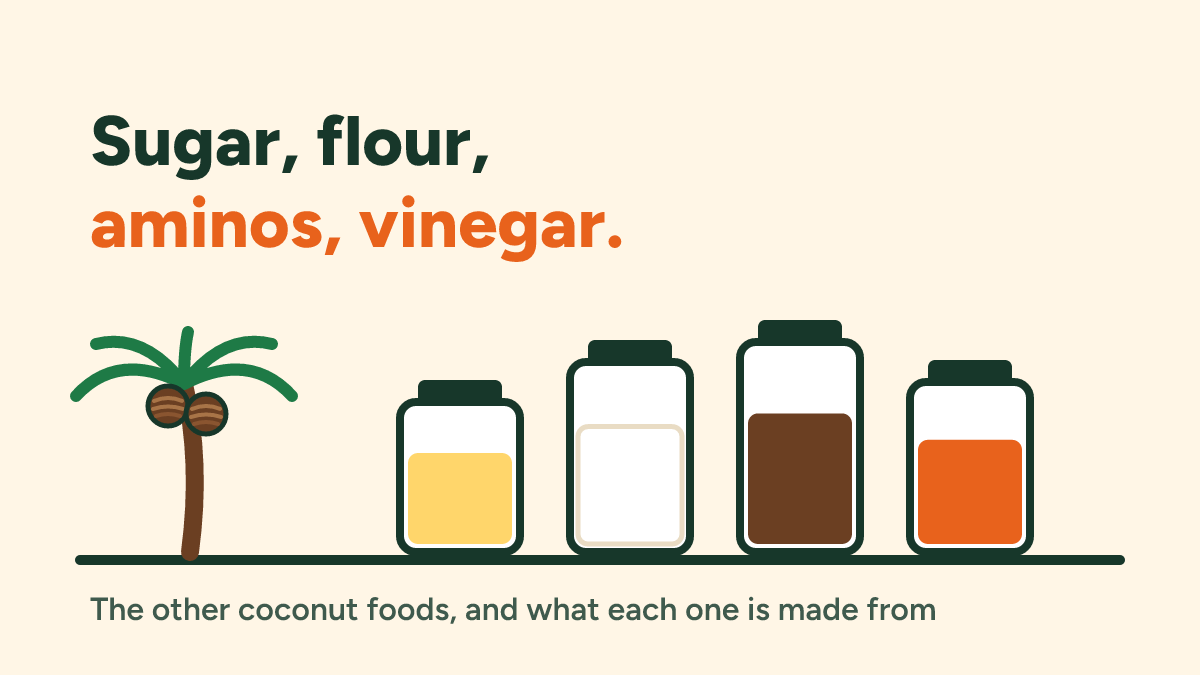
The coconut palm is harvested in two places. The nut gives flesh, milk, oil, water and flour. The flower gives sap, and the sap becomes sugar, nectar, aminos and vinegar.
For an allergy that difference matters, because the allergy is to protein, and these foods carry very different amounts of it.
What each one is
| Food | What it is made from | Protein per 100 g |
|---|---|---|
| Coconut flour | The flesh, dried, after most of the oil or milk has been pressed out [1] | 16.1 g [2] |
| Coconut butter, "manna" | Whole flesh, ground [3] | 6.5 to 7.1 g [3] |
| Desiccated coconut | Flesh, shredded and dried [4] | 6.9 g [2] |
| Coconut cream | Pressed from the flesh. Coconut milk and cream | 3.6 g [2] |
| Fresh coconut flesh | 3.3 g [2] | |
| Coconut milk | Pressed from the flesh, with water | 2.3 g [2] |
| Coconut water | The liquid inside the nut | 0.7 g [2] |
| Coconut sugar | Sap from the unopened flower, boiled until it crystallises [5] | 0 on labels; 2.6 g in one laboratory analysis [3, 6] |
| Coconut nectar or syrup | The same sap, as a syrup [6] | 0 on labels [3] |
| Coconut aminos | The sap, fermented, with salt [7] | 0 on most labels [3] |
| Coconut vinegar | Fermented sap, or fermented coconut water [3, 6] | 0 on labels [3] |
"0 on labels" means below what a label has to declare for a small serving. It does not mean none.
Coconut flour: the one to take most seriously
Coconut flour is what is left of the flesh when the fat has been taken out. Take away fat and water and what remains is fibre and protein. At 16 g per 100 g it has about five times the protein of fresh coconut [2].
So if you react to coconut as a food, coconut flour is the most concentrated form of what you react to. It also turns up in things that don't taste of coconut:
- Siete grain-free tortilla chips: cassava flour, avocado oil, tapioca starch, coconut flour [8]
- Simple Mills banana muffin mix and chocolate chip cookie mix: almond flour, coconut sugar, coconut flour. The allergen line on both reads "Contains: almonds" [8].
"Grain-free", "paleo" and "keto" on the front are the signal. Food shopping, aisle by aisle.
A side note, because you may run into it: one allergy academy answer gives coconut flesh as 16% protein [9]. The USDA figure for raw flesh is 3.3%; 16.1% is its figure for coconut flour [2].
The sap products: nobody has looked
Coconut sugar, nectar, aminos and vinegar all start as sap tapped from the flower stalk before it opens [5]. No part of the nut is involved.
That makes it tempting to say they are a different thing and leave it there. The evidence doesn't allow that, in either direction:
- No study has tested whether coconut sap or anything made from it causes allergic reactions. We searched and found none.
- No case report of a reaction to coconut sugar or aminos.
- No allergy organisation we found mentions them. Anaphylaxis UK's coconut factsheet lists milk, water, creamed and desiccated coconut, and says nothing about sugar, flour, aminos or vinegar [10].
- The sap is not protein-free. One analysis of coconut sap sugar found 2.6 g of protein per 100 g [6]. Whether any of that is a protein people are allergic to, nobody knows; the allergens in coconut have not been well characterised even in the flesh [9].
So the answer is "unknown". If these foods matter to you, that is a question for your allergist and, if it is worth settling, a supervised test. It is not something to try at home after a serious reaction to coconut.
Where they turn up
Coconut sugar and aminos are the standard sweetener and soy-sauce replacement in "clean label" food. From the makers' own pages [8]:
| Product | What the list says | Allergen statement |
|---|---|---|
| Hu chocolate (Vanilla Crunch) | Organic cacao, unrefined organic coconut sugar, cocoa butter | "Contains coconut" |
| Purely Elizabeth granola | Oats, organic coconut sugar, organic coconut oil | "Contains: coconut and almonds" |
| Simple Mills cookie mix | Almond flour, chocolate chips, coconut sugar, tapioca, coconut flour | "Contains: almonds" |
| Primal Kitchen teriyaki and BBQ sauces | Organic coconut aminos (organic coconut syrup, water, salt) | |
| Kevin's Natural Foods orange chicken | Coconut sugar, coconut aminos (coconut nectar, water, sea salt) | |
| Kevin's Natural Foods honey garlic sauce | Coconut aminos (coconut nectar, water, sea salt) | "Allergens: none" |
| Epic maple bacon pork cracklings | Described as seasoned with maple and coconut sugar |
Two of those give an allergen statement that doesn't mention coconut. That is allowed: see the last section.
Read teriyaki, stir-fry sauces, marinades, ready meals and granola. Those are where aminos and coconut sugar go without the word coconut on the front.
The names
The same sap is written several ways. On aminos alone, three brands list their one main ingredient as "coconut tree sap", "coconut blossom nectar" and "nira" [7], and others as "coconut syrup" [8].
Look for: coconut sugar, coconut palm sugar, coconut blossom sugar, coconut nectar, coconut syrup, coconut sap, coconut aminos, coconut vinegar, toddy and nira.
"Palm sugar" may not be coconut
Sugar is made from the sap of several palms, and "palm sugar" covers all of them. The FAO names the sugar palm, the palmyra and the wild date palm as sources, and a review of coconut sugar adds the nipa palm alongside the coconut [6, 11]. A label that says only "palm sugar" doesn't tell you which.
The traditional names don't settle it either. Gula aren is specifically the sugar palm [6]. But gula melaka and jaggery are used in the scientific literature for cane sugar as well [12].
If a product lists "palm sugar", the maker is the only one who knows which palm. Coconut's relatives.
Two more to know
- Coconut milk powder is often not just coconut. Labels list maltodextrin and, in some, sodium caseinate, which is a milk protein [3]. That matters if milk is your other allergy.
- Coconut chips and "coconut bacon" are the flesh, sliced and seasoned [3].
What the label has to say
United States. Coconut is no longer a major allergen for labelling, so it should not appear in a "Contains" statement, though you will keep seeing it there for a few years while labels are reprinted. It must still be in the ingredient list by name. The FDA notes one exception: a natural coconut flavour may be listed simply as "natural flavor" [13].
European Union and UK. Coconut is not among the nuts the law requires to be emphasised [14]. It still has to be listed.
Either way: the ingredient list, every time, and not the allergen line. How to read a label.
What to do
- Avoid coconut flour if you react to coconut as a food. It is concentrated flesh.
- Treat sugar, nectar, aminos and vinegar as unknown, and ask your allergist. Don't assume either way.
- Read sauces and "grain-free" baking for these four words.
- Ask about "palm sugar" if it matters; the label won't tell you.
- Cooking at home? What to use instead.
Related
Foods to avoid · Food shopping · Cooking without coconut · Coconut water allergy · The complete guide
Sources
- Tetra Pak. Coconut Handbook, chapter on coconut food production. tetrapak.com
- USDA FoodData Central: coconut flour · desiccated coconut · coconut cream · raw coconut meat · coconut milk · coconut water
- USDA FoodData Central, branded food records (label data), read October 2026. fdc.nal.usda.gov
- Codex Alimentarius. Standard for desiccated coconut (CXS 177-1991). PDF
- Philippines. Draft national standard, code of hygienic practice for coconut sap sugar, notified to the WTO in 2015. PDF
- Saraiva A. et al. Review of coconut sugar. International Journal of Environmental Research and Public Health, 2023. PMC
- Manufacturers' pages: Coconut Secret · Bragg · Big Tree Farms
- Manufacturers' pages, read October 2026: Siete · Simple Mills banana muffin mix · Simple Mills cookie mix · Hu · Purely Elizabeth · Primal Kitchen teriyaki · Primal Kitchen BBQ · Kevin's orange chicken · Kevin's honey garlic sauce · Epic
- AAAAI, Ask the Expert. “Coconut.” November 2025. aaaai.org
- Anaphylaxis UK. “Coconut allergy” factsheet, 2019. PDF
- FAO. Tropical Palms, 2010 revision, chapter 4. PDF
- Review of non-centrifugal cane sugar. Foods, 2023. PMC
- US FDA. “Frequently Asked Questions: Food Allergen Labeling Guidance for Industry.” fda.gov
- Regulation (EU) No 1169/2011, Annex II. legislation.gov.uk
Educational only, not medical advice. Always confirm with your allergist.