I bought a shampoo labelled “NO COCONUT OIL”. It has coconut in it.
A Chebe shampoo whose front label promises no coconut oil has cocamidopropyl betaine as its third ingredient — made from coconut oil. I never read the list, because the title above it told me I didn’t have to.
Published November 17, 2026 · 6 min read
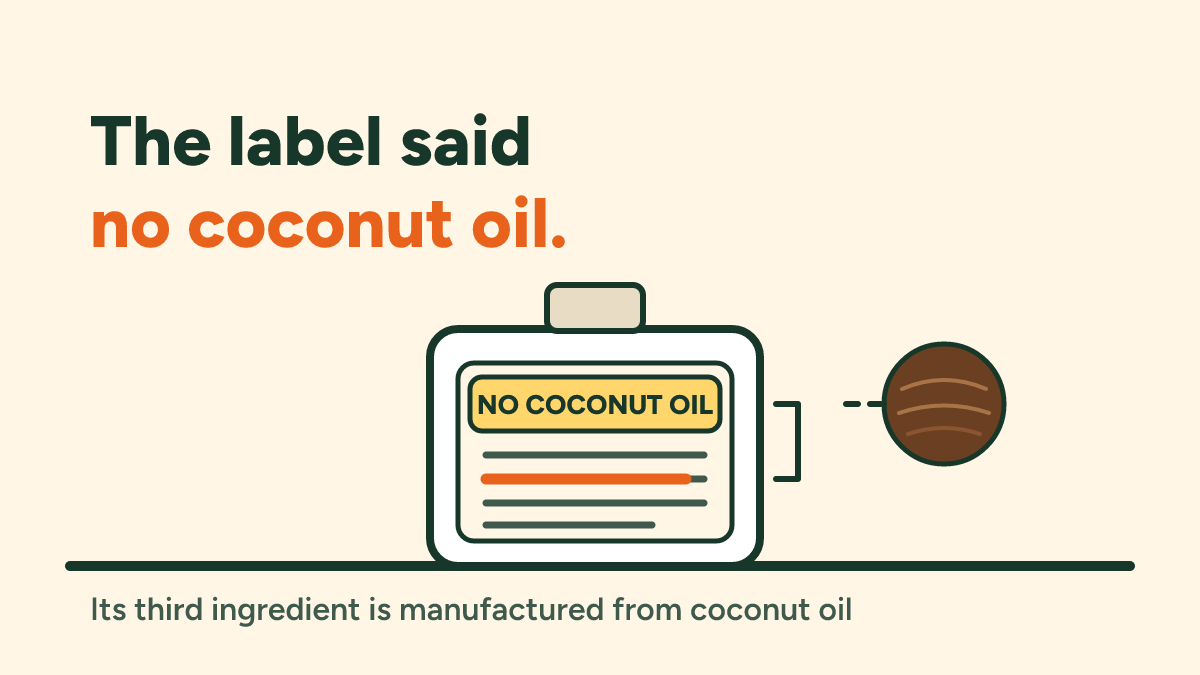
I run a website about coconut allergy. I read ingredient lists for a living. And last month I bought a shampoo, used it for weeks, and never read its ingredient list once.
Here is the part that still bothers me: the ingredient list was never hidden. It is not on the back of the bottle. It is on the front, on the same label, printed directly underneath the product name — and the product name is CHEBE SHAMPOO (NO COCONUT OIL).
So my eye landed on the title, the title answered the only question I ever ask about a product, and I stopped reading four lines above the answer. The list was right there. I looked straight past it, because the words above it told me I was done.
That is the whole problem with a claim like that. It works. It is printed exactly where your eye lands, and it offers to save you the thirty seconds of squinting at small print that I otherwise do with every product I buy. I believed it, and I stopped looking.
It is worse online, and I bought this online. In a shop I can at least pick the bottle up and hold the small print to the light. On a listing I get whatever photographs the seller chose to upload, at whatever resolution they chose — and the one thing that is always big enough to read, in every listing, on every screen, is the product name. Here the product name is the claim.
What is actually in it
The shampoo is the Naturel Bliss All Natural Chebe Shampoo, bought from their Etsy shop.
This is the label. One photograph, nothing moved and nothing taken out between the two things you are about to read.
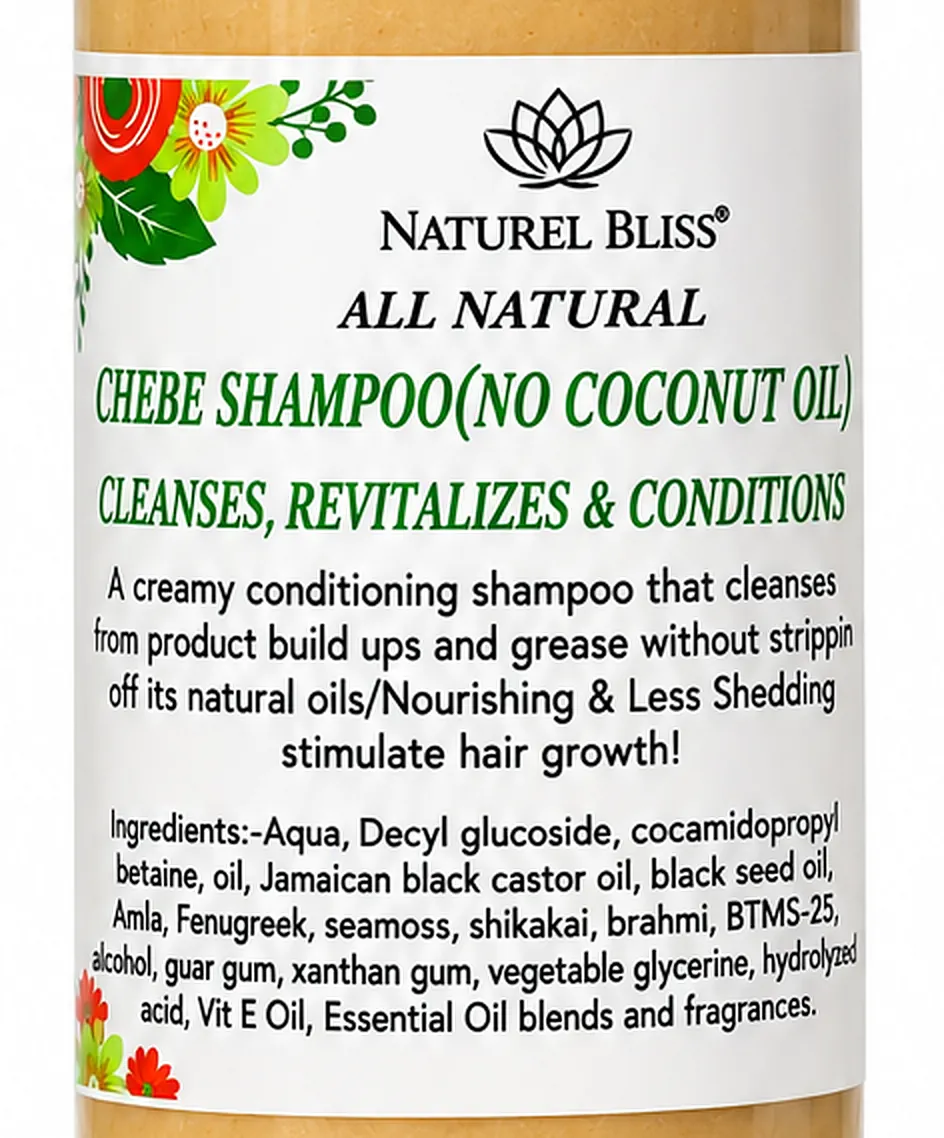
The title and the contradiction are about four centimetres apart. Here is that list:
Ingredients:-Aqua, Decyl glucoside, cocamidopropyl betaine, Aloe Vera, Babassu oil, Jamaican black castor oil…
Cocamidopropyl betaine is made from the fatty acids of coconut oil. It is the single most common coconut-derived ingredient in the world, it is in most shampoos on most shelves, and it is third on this list — not a trace, not a contaminant, a main ingredient. Decyl glucoside, second on the list, is made from coconut or palm kernel oil, and the label does not say which.
“No coconut oil” is true, and it is not the point
I want to be fair about this, because the wording is narrow and narrow wording is sometimes honest. There is no coconut oil in this bottle. Read literally, the label is telling the truth.
But look at what the claim is doing. Cocamidopropyl betaine is manufactured from coconut oil. The oil goes into the factory; this is what comes out the other end. So the sentence on the front amounts to: we did not pour coconut oil into the mixture, we poured in the thing we made out of coconut oil.
That distinction is real to a chemist. It is worth nothing to the person the claim is aimed at. Nobody with a coconut allergy is scanning a shampoo bottle hoping to avoid one specific pressing of the fruit — they are trying to find out whether the product will make them ill. “No coconut oil” answers a question nobody asked, in language that sounds exactly like the answer to the question everybody asked.
And the only people who could safely tell the difference are the people who already know enough chemistry not to need the label.
What it is like to actually use
Since I am being fair: this is not a bad product. It is a strange one.
It barely foams. There is almost no lather at all — a little slip and then nothing. Washing my hair with it took real effort, working it through section by section, and I never felt confident it had reached my scalp. If you are used to a shampoo that bubbles up, this will feel broken.
And this is the part that genuinely makes me angry, because what is the point?
Cocamidopropyl betaine is in shampoo for one reason: foam. That is its job. That is why the whole industry uses it, and it is why every shampoo I have ever checked has coconut in it. You put up with the coconut because you want lather.
This shampoo has the coconut and does not give you the lather. Chebe formulas are thick with powder and oil, and all of that kills the foam — so the surfactant is in there, second and third on the list, and you cannot tell. You are carrying the entire risk of the ingredient and receiving none of the thing it was added for.
That is the worst of both worlds. If the foam was never going to survive the formula anyway, leave the coconut out. Nothing was gained by putting it in.
And yet my hair genuinely loved it. That is the frustrating part. It came out soft, thick and conditioned in a way that most shampoos do not manage — and none of that is coming from the cocamidopropyl betaine. It is coming from the chebe, the oils and the butters. Which is the same argument again: the one ingredient I cannot have is the one doing the least work in the bottle. If the formula did not contain coconut I would buy it again tomorrow.
Why I am annoyed about it
Because a coconut claim on a bottle is not a marketing adjective. It is not like “radiant” or “nourishing” or “clean beauty”. It is a safety claim, and the only people who go looking for one are people who get sick.
If you print it on a bottle you are talking to a specific person: someone who has learned to read every label, who has been let down before, and who is tired. Printing it means that person can stop checking. That is the entire value of the words. That is why I stopped checking.
For most buyers a wrong claim is a disappointment. For someone with a coconut allergy it is the reason they bought the thing.
What I have done
I have written to Naturel Bliss. I have asked them either to make the wording clearer about what it does and does not cover, or to tell me what they understand “no coconut oil” to mean on a bottle whose third ingredient is made from coconut oil. I will publish their answer here when it comes — the same as I do with every brand I write to, whether the answer is good or bad.
I am not asking anyone to boycott a small business. I am asking for the title on the label to match the list four lines underneath it.
The lesson, including for me
Read the ingredient list. Every time. Even when the words above it say you don't have to. Especially then.
I know this. I built a whole website on it. And a big friendly promise in capital letters still walked straight past me — not past a sealed box or a hidden panel, past four centimetres of white label with the answer printed on it. That is how well those claims work, and how little they are policed.
One more thing worth saying, because it cuts the other way: the same brand's Chebe Conditioner with Ambunu has no coconut in it at all. Jojoba, argan, grapeseed, sweet almond. Nothing on the list is coconut-derived. Same shop, same range, completely different answer — which is the rule I keep relearning: judge the formula, never the brand.
If you want to know why shampoos are so consistently the worst category for this, I wrote about that separately: “sulfate-free” makes coconut more likely, not less.
Educational only, not medical advice. Always confirm with your allergist.